
Specialize in Compression molds
Specialize in Compression molds
A bathtub mould is not simply a tool for creating the required shape. Large composite bathtub components have relatively large forming surfaces and often require strict control of dimensional accuracy, surface finish, wall geometry, and demoulding performance.
For composite and SMC bathtubs, the mould surface is directly transferred to the finished product. Accurate cavity machining, appropriate draft angles, reliable mould structure, effective venting, and controlled thermal conditions all contribute to stable production and repeatable product quality.
At MDC, we manufacture customized bathtub moulds and composite tooling for sanitaryware applications. Our mould solutions are developed around practical production requirements, including product geometry, material behavior, surface appearance, production volume, and demoulding conditions.
Bathtub moulds have several characteristics that make their design different from smaller composite tooling applications. A bathtub typically has a relatively large cavity, broad curved surfaces, deep forming areas, and visible cosmetic surfaces. These characteristics increase the importance of mould rigidity, machining accuracy, surface finishing, and thermal consistency.
A large composite bathtub mould must maintain its geometry while handling repeated molding cycles. Even relatively small dimensional deviations across a large cavity can become noticeable in the finished bathtub.
Important tooling considerations include:
The objective is not simply to manufacture a mould that produces one acceptable part, but to create tooling capable of maintaining consistent quality throughout repeated production cycles.
The cavity surface of a bathtub mould has a direct influence on the appearance of the finished bathtub. Unlike hidden structural components, bathtubs are highly visible products where surface quality is an important part of the customer's perception of the final product.
A properly finished cavity can help reproduce a smooth and consistent surface while reducing unnecessary post-processing on the molded bathtub.
Surface quality starts with accurate machining. CNC machining establishes the basic cavity geometry and determines how consistently the final surface can be finished.
Machining errors, excessive tool marks, local steps, or uneven transitions can make subsequent polishing more difficult and may become visible on the finished product.
After machining, critical cavity surfaces may require grinding and polishing according to the required bathtub appearance. The final surface condition should be selected based on the product's cosmetic requirements and manufacturing process.
A well-prepared mould surface can provide several production benefits:
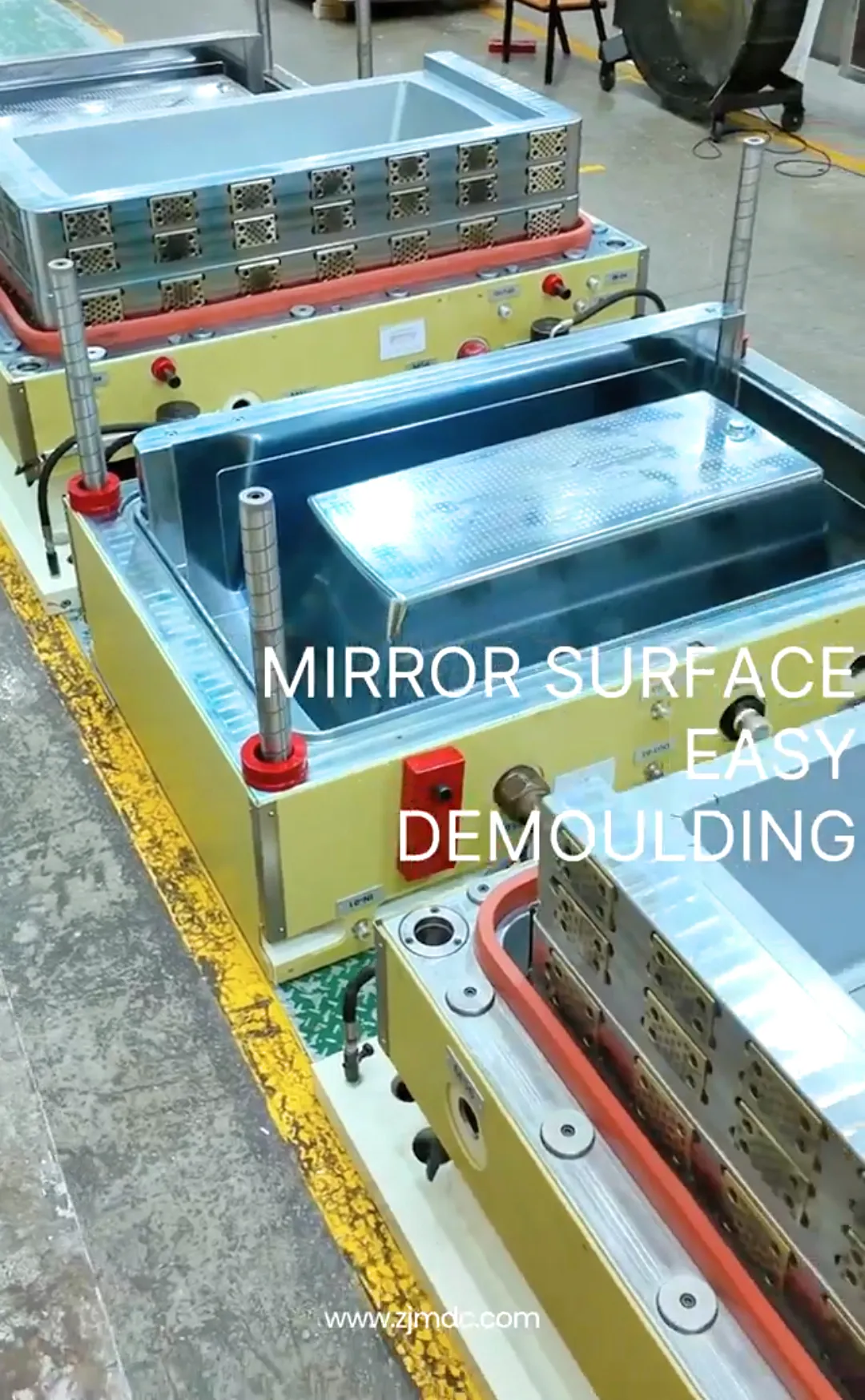
Dimensional accuracy is particularly important for large bathtub moulds because the finished product must maintain the intended overall geometry while also fitting associated components such as frames, supports, drains, panels, seals, or installation structures.
An accurately manufactured bathtub mould provides a stable reference for the finished composite component. Critical dimensions should therefore be identified during the mould design stage and controlled throughout machining and inspection.
Large cavity surfaces require careful machining and inspection because small deviations can accumulate across the forming area. The mould structure must also provide sufficient rigidity to minimize deformation during manufacturing and operation.
Composite materials can experience dimensional changes during curing and cooling. The mould design should take the expected material behavior into consideration so that the finished bathtub can achieve the required dimensions.
The exact compensation strategy depends on the material system, molding process, product geometry, and processing conditions.
Where the bathtub interfaces with drains, support structures, covers, panels, or other components, the corresponding mould features require additional attention.
Maintaining these critical dimensions helps improve assembly consistency and reduces the need for corrective operations during final production.
Because a bathtub has a relatively deep and curved cavity, demoulding must be considered from the beginning of the tooling design process. A mould that produces the correct geometry but cannot release the part reliably is not an efficient production mould.
Draft angles provide clearance between the molded part and the mould surface during separation. The required draft depends on the bathtub geometry, surface finish, material characteristics, and production process.
Insufficient draft may increase demoulding force and create risks such as:
For complex bathtub geometries, engineers must consider deep sections, sharp transitions, local ribs, mounting features, and areas where the product may mechanically lock against the cavity.
The size of a bathtub makes mould rigidity an important engineering consideration. Large tooling surfaces can be affected by mechanical loads, thermal expansion, handling, and repeated production cycles.
A rigid bathtub compression mould helps maintain the designed cavity geometry and reduces the risk of deformation during molding.
The supporting structure should be designed according to:
Adequate structural support is particularly important when the tooling is used repeatedly in medium- or high-volume production.
Temperature control becomes increasingly important as the size of the bathtub mould increases. A large cavity requires a stable thermal environment so that the composite material can flow and cure consistently across the entire forming surface.
An improperly balanced heating system may create temperature differences between different areas of the mould. These differences can influence curing behavior, material flow, surface quality, and dimensional stability.
For a bathtub compression mould, the heating system should therefore be considered together with the mould structure and cavity geometry rather than treated as an independent component.
Large flat or curved areas may require carefully positioned heating elements or heating channels to minimize temperature differences across the cavity. The objective is to provide stable and repeatable thermal conditions throughout the production cycle.
Uniform temperature distribution can help reduce:
A bathtub mould used for continuous production experiences repeated heating and cooling cycles. The tooling structure and heating system should therefore be designed with long-term thermal stability in mind.
Consistent thermal performance helps manufacturers maintain more predictable production conditions and reduces the need for frequent process adjustments.
Effective venting is another important consideration when designing a composite bathtub mould. During molding, air and gases inside the cavity need to escape as the material fills the mould.
If air becomes trapped in difficult-to-fill areas, the finished bathtub may develop surface imperfections, voids, incomplete filling, or localized defects.
Venting locations should be selected according to:
The objective is to provide sufficient air-release paths while controlling material leakage through the venting system.
For large bathtub components, venting should be evaluated during the mould design stage rather than added only after production problems occur.
Flash is a common concern in compression molding because excess material can escape through the mould parting surface when the cavity is compressed.
For large sanitaryware components, excessive flash increases trimming requirements and may affect the appearance or dimensional accuracy of the finished bathtub.
Flash formation can be influenced by several factors, including:
A precision bathtub mould should therefore incorporate carefully designed parting surfaces and sufficient structural rigidity to maintain stable mould closure during production.
Reducing flash at the tooling stage can also reduce downstream trimming work and improve overall manufacturing efficiency.
Large composite bathtub components can experience different types of molding defects depending on the material, tooling, equipment, and processing conditions. Understanding the relationship between a defect and its potential cause helps engineers determine the most appropriate corrective action.
| Common Problem | Possible Cause | Engineering Consideration |
|---|---|---|
| Surface Imperfections | Poor cavity finish, trapped air, contamination, or unstable molding conditions | Improve mould finishing, venting, cleaning, and process stability |
| Excessive Flash | Parting-line clearance, mould wear, excessive material, or pressure | Improve parting surfaces and review material loading and molding parameters |
| Warpage | Uneven curing, thermal imbalance, wall thickness variation, or residual stress | Optimize mould temperature distribution and review product geometry |
| Dimensional Variation | Mould deformation, material shrinkage, or unstable thermal conditions | Improve mould rigidity, dimensional compensation, and thermal control |
| Difficult Demoulding | Insufficient draft, surface adhesion, or unsuitable cavity finish | Review draft angles, surface condition, and release strategy |
| Incomplete Filling | Incorrect material loading, restricted flow, or unsuitable process conditions | Review charge placement, cavity design, material flow, and molding parameters |
| Local Surface Variation | Uneven material distribution or temperature differences | Optimize material flow and thermal balance |
It is important to understand that not every molding defect originates from the mould itself. Material properties, charge weight, loading position, molding temperature, pressure, curing time, and press performance can also influence the final result.
A complete engineering evaluation should therefore consider the mould and molding process as an integrated production system.
Trial moulding provides an important opportunity to verify whether a newly manufactured bathtub mould can achieve the required production performance.
Rather than evaluating only whether the mould can produce the correct basic shape, trial production allows engineers to examine the interaction between tooling, material, molding equipment, and process parameters.
The trial part can be inspected to verify overall dimensions, critical interfaces, cavity features, wall geometry, and other customer-defined requirements.
The molded surface is examined for defects such as uneven appearance, pits, pinholes, resin-rich areas, fiber exposure, or other abnormalities that may require tooling or process adjustments.
The release process is observed carefully to determine whether the bathtub separates smoothly from the mould without excessive force or damage.
Trial production also provides an opportunity to evaluate flash distribution and the performance of the mould parting surfaces under actual production conditions.
The information obtained during trial moulding can then be used to optimize the tooling before regular production begins.
Quality control is an important part of manufacturing large composite tooling. Because bathtub moulds contain large curved surfaces and complex geometry, inspection should cover both dimensional accuracy and functional tooling performance.
| Inspection Stage | Key Inspection Items |
|---|---|
| Raw Material Inspection | Steel grade, material certification, and condition |
| CNC Machining Inspection | Cavity dimensions, geometry, and critical tolerances |
| Surface Finishing Inspection | Polishing quality, machining marks, and cavity condition |
| Assembly Inspection | Alignment, fitting, parting surfaces, and mould structure |
| Heating System Inspection | Heating configuration and thermal performance |
| Trial Moulding | Product dimensions, surface quality, flash, and demoulding |
| Final Inspection | Compliance with approved drawings and customer specifications |
A structured inspection process helps identify tooling issues before they become repeated production problems and provides greater confidence in the long-term performance of the mould.
Successful bathtub tooling begins before machining starts. Product geometry, material selection, molding process, production volume, and available equipment should all be considered during the engineering stage.
At MDC, the development process can include:
This engineering workflow helps transform the bathtub mould from a machined tool into a production-ready tooling system capable of supporting consistent composite manufacturing.
At MDC, we manufacture customized bathtub moulds for composite and SMC sanitaryware applications. Our tooling solutions are developed according to the product structure, material system, molding process, production volume, and required surface quality.
For large bathtub tooling, our engineering approach focuses on maintaining cavity accuracy and structural stability while providing the surface finish and demoulding performance required for practical production.
The cavity geometry is manufactured using precision machining processes to reproduce the required bathtub shape accurately. Particular attention is given to large curved surfaces, transition areas, edges, and critical functional features.
MDC has experience in manufacturing tooling for composite applications, including compression moulds and other customized composite mould solutions. This experience allows the tooling design to consider material behavior and actual molding conditions rather than focusing only on the product geometry.
For visible bathtub surfaces, mould finishing is an important part of the tooling process. Grinding and polishing are performed according to the required product appearance and production requirements.
MDC develops moulds with production conditions in mind. Mould rigidity, heating, venting, parting surfaces, draft angles, and demoulding are considered during tooling development to support repeatable manufacturing.
Where required, trial moulding can be used to verify product dimensions, surface quality, flash, filling behavior, and demoulding performance. The results provide practical information for final tooling optimization.
Different bathtub manufacturers may use different composite material systems and production processes. The tooling design should therefore be developed according to the specific material and manufacturing method rather than assuming that every bathtub mould can use the same configuration.
SMC bathtub moulds are designed for compression molding applications where the material is formed and cured under controlled heat and pressure. Tooling must accommodate material flow, curing behavior, flash control, and reliable demoulding.
FRP and other composite bathtub manufacturing processes may require different tooling configurations depending on the forming and curing method. Surface quality, release performance, dimensional stability, and mould durability remain important considerations.
Beyond standard bathtub designs, composite tooling can also be developed for customized sanitaryware products with special dimensions, contours, mounting areas, or surface requirements.
The mould structure should be adapted to the actual product rather than relying on a standardized tooling design.
Providing complete technical information allows the tooling engineer to evaluate the project more accurately and develop a mould that matches the intended production process.
For a bathtub mould project, customers should ideally provide:
If the production process or material specification is still under development, the tooling design can be evaluated based on the available product information and expected manufacturing conditions.
When selecting a bathtub mould manufacturer, buyers should evaluate more than machining capability. Large composite tooling requires an understanding of product geometry, material behavior, mould structure, surface finishing, and production conditions.
Important factors to consider include:
A reliable tooling partner should be able to explain how each mould design decision supports the customer's actual production requirements, rather than simply providing a mould based on a drawing.
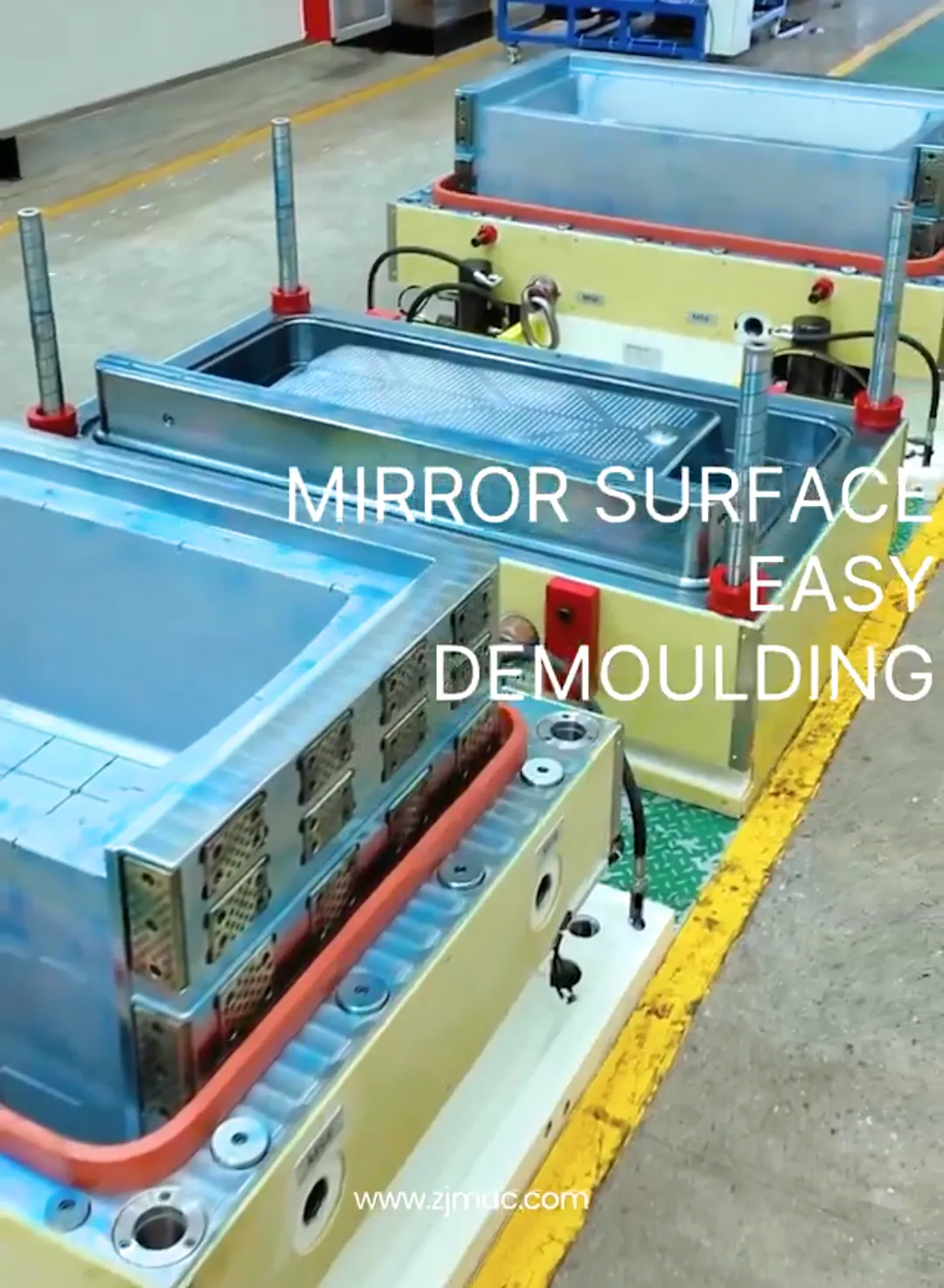
A bathtub mould is a tooling system used to form a bathtub component from materials such as SMC, FRP, or other composite materials. The mould defines the product geometry and strongly influences dimensional accuracy, surface finish, and demoulding performance.
An SMC bathtub mould is a compression mould specifically designed for forming SMC material into a bathtub or related sanitaryware component. Its design must consider material flow, curing, temperature control, flash, surface finish, and demoulding.
The mould cavity transfers its surface characteristics to the finished bathtub. A properly machined and polished cavity can help achieve a consistent appearance and reduce surface-related finishing work.
Draft angles provide clearance between the mould and the molded bathtub during demoulding. Proper draft design helps reduce release resistance and lowers the risk of scratching, deformation, or damage to the finished component.
Mould rigidity helps maintain cavity geometry under mechanical and thermal loads. Stable tooling supports dimensional consistency and reduces the risk of deformation during repeated production cycles.
Flash can be influenced by parting-line accuracy, mould wear, material charge, molding pressure, and cavity design. Accurate parting surfaces combined with appropriate material and process control can help reduce excessive flash.
The suitable material depends on the bathtub manufacturing process. Composite bathtub applications may use SMC, FRP, or other composite systems, and the mould should be designed according to the specific material and curing or forming conditions.
Yes. MDC manufactures customized bathtub moulds according to product geometry, material, molding process, production volume, surface requirements, equipment conditions, and customer specifications.
Yes. MDC manufactures customized compression moulds for SMC applications, including sanitaryware and other composite components requiring accurate cavity geometry and repeatable production performance.
Yes. A properly engineered bathtub mould can be designed for repeated production cycles. Tool material, mould rigidity, thermal management, surface finishing, maintenance, and production conditions should all be considered when determining the appropriate tooling configuration.
A successful bathtub mould does more than reproduce the basic shape of a sanitaryware product. For large composite components, cavity accuracy, surface finish, mould rigidity, draft angles, venting, thermal stability, and demoulding performance all contribute to the final production result.
The larger the forming surface, the more important it becomes to control these factors as an integrated tooling system. Accurate machining establishes the geometry, surface finishing determines the quality of the visible cavity, thermal management supports consistent processing, and proper draft and demoulding design helps protect the finished bathtub.
At MDC, we manufacture bathtub moulds, SMC bathtub moulds, compression moulds, and customized composite tooling for sanitaryware applications. From product and DFM review to CNC machining, polishing, assembly, inspection, and trial moulding, our tooling development process is focused on practical production requirements and repeatable results.
Whether you are developing a standard composite bathtub, an SMC sanitaryware product, or a customized large-format composite component, MDC can develop a mould solution based on your product geometry, material system, production process, and quality requirements.
Contact MDC to discuss your bathtub mould and composite tooling project.
Contact US
Email: master@zjmdc.com
Tel: +86 576 84616076
Fax: +86 576 84616079
Mobile: +86 13906573507(Mr. Wang)
Address: No.116 mochuang road, Huangyan Xinqian street,Taizhou,Zhejiang,China