
Specialize in Compression molds
Specialize in Compression molds
As industries continue to pursue lightweight, high-strength, and high-performance materials, carbon fiber composites have become one of the most important engineering materials across automotive, aerospace, rail transit, energy, medical, and sporting goods applications. Behind every precision composite component is a well-designed carbon fiber mold, which plays a decisive role in product quality, production efficiency, dimensional accuracy, and overall manufacturing cost.
Whether using prepreg lay-up, compression molding, resin transfer molding (RTM), or other composite manufacturing technologies, the quality of the mold directly affects fiber orientation, resin distribution, curing consistency, surface finish, and long-term tooling durability. For manufacturers producing carbon fiber structural components, investing in precision-engineered tooling is often the key to achieving stable mass production.
This guide explains everything you need to know about carbon fiber molding, including mold materials, manufacturing processes, compression molding technology, tooling design considerations, common defects, application industries, and how MDC develops customized composite molds for demanding industrial applications worldwide.
A carbon fiber mold is a precision manufacturing tool used to shape carbon fiber reinforced polymer (CFRP) components into their final geometry during the curing process. Depending on production requirements, molds may be designed for prepreg compression molding, matched metal molding, vacuum-assisted molding, RTM, or autoclave processing.
Unlike conventional metal stamping dies, carbon fiber molds must maintain highly accurate cavity dimensions while withstanding repeated thermal cycles, curing pressure, and resin chemistry. Even minor deviations in mold temperature or surface precision can significantly influence laminate quality and final mechanical performance.
The terms carbon fiber mold and carbon fiber mould describe the same tooling system, with "mold" commonly used in North America and "mould" preferred in the United Kingdom, Europe, Australia, and many Commonwealth countries.
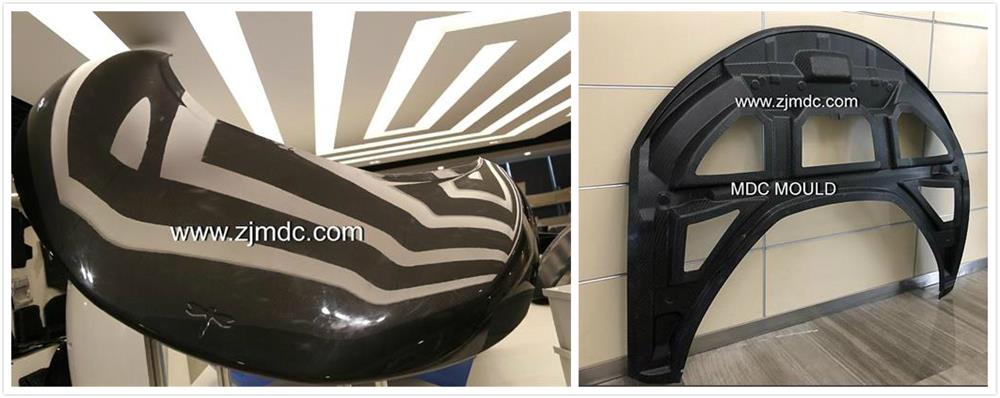
Carbon fiber molding is a manufacturing process that combines carbon fiber reinforcement with a thermosetting or thermoplastic resin under controlled heat and pressure. The objective is to consolidate multiple fiber layers into a rigid, lightweight component with exceptional mechanical properties. Unlike traditional metal forming, composite molding relies on resin curing rather than plastic deformation, making precise process control essential.
A complete molding cycle typically begins with material preparation and ends with trimming and quality inspection. Every stage influences the final performance of the composite part, from fiber alignment and resin flow to curing uniformity and dimensional stability.
For high-volume production, each step must be standardized to minimize cycle time while maintaining consistent part quality. Modern automated production lines integrate robotic material loading, servo-controlled presses, and real-time temperature monitoring to improve repeatability and reduce manufacturing variation.
Among various composite manufacturing technologies, carbon fiber compression molding has become one of the most efficient solutions for producing high-strength structural components in medium- and high-volume applications. The process places prepared carbon fiber materials into a matched mold cavity, where heat and pressure consolidate the laminate while the resin cures into a rigid structure.
Compared with traditional hand lay-up processes, compression molding provides shorter production cycles, higher dimensional consistency, improved surface quality, and better suitability for automated manufacturing. These advantages make it widely used in automotive lightweight structures, battery enclosures, industrial equipment, and transportation components.
| Parameter | Typical Range | Purpose |
|---|---|---|
| Mold Temperature | 120–180°C | Ensures complete resin curing and stable material flow. |
| Forming Pressure | 5–20 MPa | Consolidates fiber layers and reduces internal voids. |
| Curing Time | 3–20 minutes | Depends on resin system, laminate thickness, and part geometry. |
| Cooling Method | Controlled cooling | Minimizes residual stress and dimensional distortion. |
The exact processing window depends on the resin chemistry, fiber architecture, part thickness, and tooling design. Maintaining stable temperature distribution across the mold surface is particularly important because uneven heating may cause inconsistent curing, fiber print-through, or localized warpage.
Many manufacturers focus primarily on carbon fiber materials while overlooking the influence of tooling. In reality, the mold is one of the most critical factors affecting composite part quality. A well-designed mold not only shapes the component but also controls resin flow, fiber consolidation, heat transfer, venting efficiency, and dimensional accuracy throughout the curing cycle.
Even premium carbon fiber prepreg cannot compensate for deficiencies in tooling design. Poor mold construction often results in unstable production, excessive scrap rates, and inconsistent mechanical performance.
For precision industries such as automotive and aerospace, tooling accuracy directly influences assembly fit, structural integrity, and downstream manufacturing efficiency. As production volumes increase, the economic benefits of high-quality tooling become even more significant.
Different composite manufacturing processes require different mold configurations. The selection depends on production volume, component complexity, dimensional tolerance, surface quality requirements, and investment budget.
| Mold Type | Main Features | Typical Applications |
|---|---|---|
| Compression Mold | Matched male and female tooling with high forming pressure. | Automotive structural parts, battery covers, industrial panels. |
| RTM Mold | Closed mold with resin injection channels. | Complex hollow structures and medium-volume production. |
| Vacuum Bag Mold | Uses vacuum pressure for laminate consolidation. | Prototype parts, marine components, aerospace structures. |
| Autoclave Mold | Designed for high-pressure curing inside an autoclave. | Aircraft components and premium-performance composites. |
| Prototype Mold | Cost-effective tooling for product validation and development. | Low-volume production and engineering samples. |
Each molding technology offers unique advantages. Compression molding is generally preferred for mass production due to its short cycle time and excellent repeatability, while autoclave processing remains the benchmark for aerospace-grade composite quality.
The performance and service life of a carbon fiber mold depend not only on its structural design but also on the tooling material selected. Different mold materials offer varying levels of hardness, thermal conductivity, wear resistance, corrosion resistance, and machining efficiency. Choosing the right material requires balancing production volume, curing temperature, part complexity, and investment cost.
For prototype tooling, aluminum alloys are often selected because of their excellent thermal conductivity and fast machining speed. For medium- and high-volume production, hardened tool steels provide superior dimensional stability and long-term durability under repeated heating and cooling cycles.
| Tooling Material | Main Advantages | Typical Applications |
|---|---|---|
| P20 Tool Steel | Cost-effective, easy machining, good toughness | Prototype molds and medium-volume production |
| 718 Steel | Improved hardness and polishing performance | Automotive composite components |
| H13 Tool Steel | Excellent thermal fatigue resistance and long service life | High-volume compression molding |
| S136 Stainless Steel | Superior corrosion resistance and mirror polishing capability | High-gloss composite parts and precision molds |
| Aluminum Alloy | Lightweight, fast heating, rapid machining | Prototype tooling and product development |
Selecting the proper tooling material can significantly improve production stability, reduce maintenance frequency, and extend mold life, especially in applications requiring continuous production under elevated curing temperatures.
A successful carbon fiber mould is far more than a precisely machined cavity. Effective tooling design integrates thermal management, structural rigidity, resin flow control, venting efficiency, demolding performance, and manufacturing repeatability into a single engineering solution.
Every design decision directly affects production efficiency and finished part quality. Even small improvements in mold structure can reduce cycle time, minimize defects, and improve dimensional consistency over thousands of molding cycles.
Temperature consistency is one of the most important factors in composite molding. Uneven heating can cause resin to cure at different rates across the part, resulting in warpage, residual stress, fiber print-through, or inconsistent mechanical properties.
Well-designed heating channels help maintain uniform platen temperature throughout the mold cavity, allowing every section of the laminate to cure under nearly identical conditions.
Air trapped inside the mold cavity can produce voids, pinholes, dry spots, and incomplete laminate consolidation. Proper venting channels allow gases generated during curing to escape while preventing excessive resin loss.
For structural composite components, effective venting is essential for achieving high fiber volume fractions and reducing internal defects.
Precision CNC machining ensures accurate cavity dimensions, consistent laminate thickness, and reliable assembly with downstream components. Tight machining tolerances also reduce secondary fitting operations after molding.
High-quality polishing improves composite surface appearance while reducing demolding resistance. For Class-A exterior panels, mirror-polished mold surfaces help minimize fiber print-through and produce excellent paint-ready finishes.
Proper draft angles, ejector layouts, and parting line design allow molded components to be removed safely without damaging delicate carbon fiber laminates. Effective demolding also shortens production cycles and protects mold surfaces from unnecessary wear.
Although carbon fiber composites offer exceptional strength-to-weight ratios, the molding process presents several technical challenges. Most production defects originate from improper process control, tooling design, or material handling rather than the carbon fiber itself.
| Common Defect | Possible Cause | Recommended Solution |
|---|---|---|
| Voids | Entrapped air or insufficient pressure | Improve venting and optimize molding pressure |
| Dry Spots | Incomplete resin flow | Adjust material placement and curing parameters |
| Delamination | Poor laminate consolidation | Increase pressure and improve lay-up quality |
| Fiber Wrinkles | Improper fabric positioning | Optimize lay-up sequence and mold geometry |
| Surface Pinholes | Gas entrapment during curing | Improve venting system and temperature control |
| Warping | Uneven cooling or residual stress | Maintain balanced mold temperature and controlled cooling |
| Thickness Variation | Inconsistent pressure distribution | Optimize mold parallelism and pressing parameters |
Many of these issues can be minimized during the mold design stage. Proper cavity engineering, balanced heating systems, accurate machining, and optimized venting significantly improve process stability while reducing production costs associated with rework and scrap.
As composite components become increasingly complex, manufacturers demand tighter tolerances, improved repeatability, and shorter production cycles. Precision mold manufacturing is therefore essential for ensuring that every molded part meets design specifications throughout the entire production life of the tooling.
At MDC, mold manufacturing combines advanced CNC machining, precision EDM, coordinate measuring inspection, and controlled polishing processes to achieve high dimensional accuracy and excellent surface quality. Every tooling project is developed with close attention to structural rigidity, thermal balance, machining precision, and long-term production reliability.
By combining engineering experience with advanced manufacturing equipment, MDC delivers custom carbon fiber molds that support consistent product quality, efficient production, and reduced lifecycle costs for customers across a wide range of industries.
Thanks to its exceptional strength-to-weight ratio, corrosion resistance, fatigue performance, and design flexibility, carbon fiber molding has become an essential manufacturing technology across numerous industries. As lightweight engineering continues to drive innovation, manufacturers are increasingly replacing traditional steel and aluminum components with carbon fiber composites to improve performance while reducing overall weight.
Modern carbon fiber molds support the production of both structural and cosmetic composite parts, from high-volume automotive components to precision aerospace structures. Selecting the appropriate molding process and tooling solution depends on production volume, mechanical requirements, surface finish expectations, and overall project cost.
The automotive sector is one of the fastest-growing markets for carbon fiber composites. Electric vehicle manufacturers, premium automotive brands, and commercial vehicle producers are increasingly adopting lightweight composite structures to improve energy efficiency, driving range, handling performance, and crash safety.
Compression molding is particularly suitable for medium- and high-volume automotive production because it offers short cycle times, excellent dimensional consistency, and high production efficiency.
Typical automotive applications include:
Aircraft manufacturers demand extremely lightweight materials without compromising structural integrity. Carbon fiber composites provide outstanding stiffness, fatigue resistance, and dimensional stability, making them ideal for aerospace applications where every kilogram saved contributes to improved fuel efficiency.
High-precision composite tooling enables manufacturers to produce complex aerospace components with tight dimensional tolerances and premium surface quality.
Typical aerospace components include:
Railway manufacturers utilize carbon fiber composites to reduce vehicle weight while maintaining high structural strength and long-term durability. Lightweight train components contribute to lower energy consumption and improved operational efficiency.
Carbon fiber composites are increasingly used in renewable energy systems, industrial automation, and high-performance machinery where lightweight construction and corrosion resistance are essential.
Medical device manufacturers benefit from the high strength, dimensional stability, and X-ray transparency of carbon fiber composites. These characteristics make carbon fiber suitable for advanced diagnostic and treatment equipment.
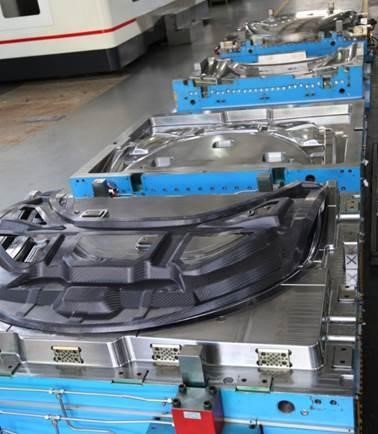
At MDC, every carbon fiber mold is engineered to achieve reliable performance throughout its entire production life. Rather than focusing solely on machining accuracy, our engineering team considers the complete molding process, including thermal balance, structural rigidity, resin flow behavior, venting efficiency, demolding performance, and long-term tooling durability.
Each project begins with a detailed evaluation of the customer's product design, production targets, material system, and manufacturing process. This collaborative approach allows potential challenges to be identified early, helping reduce development time and improve production efficiency.
Before mold manufacturing begins, our engineers perform Design for Manufacturability (DFM) analysis to evaluate part geometry, draft angles, laminate thickness, demolding feasibility, and tooling structure. Optimizing these factors at the design stage helps minimize manufacturing risks and improves production consistency.
Advanced CNC machining centers are used to manufacture complex mold cavities with high dimensional accuracy. Careful machining strategies help maintain cavity precision while ensuring efficient production of intricate composite tooling.
Uniform mold temperature is critical for consistent resin curing. MDC designs balanced heating layouts that promote even heat distribution across the entire molding surface, reducing thermal gradients and improving dimensional stability.
Depending on product requirements, mold surfaces are polished to achieve excellent surface finishes that improve part appearance and facilitate smooth demolding. High-quality polishing also contributes to longer mold service life by reducing surface wear during repeated production cycles.
Every mold undergoes dimensional inspection before delivery. When required, trial molding is performed to verify cavity accuracy, product appearance, dimensional consistency, and overall molding performance before shipment.
Selecting the right mold manufacturer is just as important as selecting the right composite material. Reliable tooling directly influences production efficiency, product quality, maintenance costs, and long-term manufacturing stability.
With years of experience in compression mold manufacturing and composite tooling development, MDC supplies customized carbon fiber molds for customers in the automotive, aerospace, energy, transportation, and industrial sectors.
Whether your project involves a lightweight automotive component, a complex aerospace structure, or a custom industrial composite part, MDC is committed to delivering tooling solutions that combine precision, durability, and manufacturing efficiency.
Several manufacturing technologies are available for producing carbon fiber composite components. Each process offers unique advantages depending on production volume, component complexity, tooling investment, and performance requirements. Understanding these differences helps manufacturers select the most suitable process for their applications.
| Process | Production Volume | Surface Quality | Cycle Time | Typical Applications |
|---|---|---|---|---|
| Compression Molding | Medium to High | Excellent | Short | Automotive structural parts, battery covers, industrial panels |
| RTM (Resin Transfer Molding) | Medium | Very Good | Medium | Complex hollow composite structures |
| Vacuum Bag Molding | Low | Excellent | Long | Prototype and customized composite parts |
| Autoclave Molding | Low | Premium | Long | Aerospace and high-performance racing components |
Among these technologies, compression molding has become the preferred choice for manufacturers seeking high productivity, stable quality, and competitive production costs. When combined with precision-engineered carbon fiber molds, the process delivers excellent repeatability and supports large-scale manufacturing without sacrificing component performance.
Selecting a carbon fiber mold requires more than comparing prices. A well-designed mold should support stable production over thousands of molding cycles while maintaining consistent dimensional accuracy and surface quality.
Before choosing a mold manufacturer, engineers and purchasing teams should evaluate several technical factors:
Working with an experienced mold manufacturer from the early design stage can shorten development time, optimize production efficiency, and reduce the overall lifecycle cost of composite manufacturing.
A carbon fiber mold is a precision tool used to manufacture carbon fiber composite components through processes such as compression molding, RTM, vacuum bag molding, or autoclave curing. It defines the final shape, dimensional accuracy, and surface quality of the finished part.
There is no technical difference. "Mold" is the preferred spelling in American English, while "mould" is commonly used in British English and many Commonwealth countries.
Compression molding is widely recognized as one of the most efficient methods for medium- and high-volume production because it offers short cycle times, consistent product quality, and excellent repeatability.
Carbon fiber molding is widely used in automotive, aerospace, rail transportation, renewable energy, medical equipment, industrial machinery, marine engineering, and sporting goods manufacturing.
Common tooling materials include P20 steel, 718 steel, H13 tool steel, S136 stainless steel, and aluminum alloys. Material selection depends on production volume, curing temperature, and tooling life requirements.
Uniform mold temperature ensures consistent resin curing, minimizes residual stress, reduces deformation, and improves both mechanical performance and dimensional stability.
The service life depends on tooling material, manufacturing quality, maintenance practices, molding pressure, and production conditions. High-quality steel molds used under proper operating conditions can support many thousands of molding cycles.
Yes. Custom molds can be designed according to part geometry, composite material, production volume, surface finish requirements, and customer-specific manufacturing processes.
As demand for lightweight, high-performance composite products continues to grow, precision carbon fiber molds have become a critical factor in achieving efficient, repeatable, and cost-effective manufacturing. From automotive lightweight components and battery enclosures to aerospace structures and industrial equipment, the quality of the mold directly influences every stage of the molding process.
Successful carbon fiber molding requires more than advanced materials. It depends on precise mold design, balanced heating systems, accurate machining, effective venting, and comprehensive engineering expertise. By integrating these elements into every project, manufacturers can improve product quality, shorten production cycles, and reduce long-term manufacturing costs.
With extensive experience in compression mold manufacturing and composite tooling development, MDC provides customized carbon fiber mold solutions for customers worldwide. From concept evaluation and DFM analysis to precision machining, trial molding, and technical support, our team is committed to delivering reliable tooling that helps customers achieve consistent production and long-term business success.
Contact US
Email: master@zjmdc.com
Tel: +86 576 84616076
Fax: +86 576 84616079
Mobile: +86 13906573507(Mr. Wang)
Address: No.116 mochuang road, Huangyan Xinqian street,Taizhou,Zhejiang,China