
Specialize in Compression molds
Specialize in Compression molds
As industries accelerate toward lightweight structures, recyclability, and high-volume production efficiency, the GMT tool has become a critical element in modern thermoplastic composite manufacturing. Glass Mat Thermoplastic (GMT) materials, combined with precision compression tooling, provide an ideal balance between mechanical performance, durability, and sustainable production.
For manufacturers with expertise in compression molding, GMT tooling represents a natural and strategic extension beyond traditional thermoset composite molds.
A GMT tool is a compression mold specifically engineered for forming Glass Mat Thermoplastic (GMT) materials under controlled heat and pressure. GMT sheets consist of randomly oriented glass fiber mats impregnated with thermoplastic resins such as polypropylene (PP) or polyamide (PA).
Unlike thermoset-based SMC tooling, GMT compression tooling operates through a heating–forming–cooling cycle rather than a chemical curing reaction. This fundamental difference places higher demands on thermal control, mold rigidity, and dimensional stability.
GMT materials soften when heated and solidify upon cooling. As a result, GMT tooling must provide:
Repeated thermal cycling makes mold material selection and internal structure essential for long-term tooling durability.
Although GMT uses randomly oriented glass fibers, proper compression mold design ensures controlled material flow, uniform wall thickness, and consistent fiber distribution in load-bearing areas.
A well-designed GMT tool directly influences stiffness, impact resistance, and fatigue performance of the finished composite component.
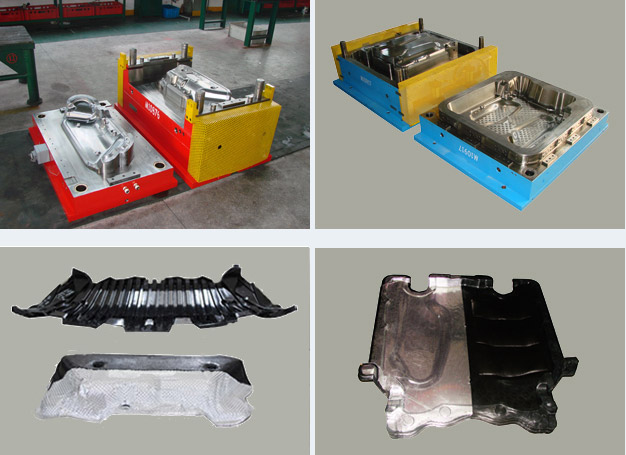
One of the most significant advantages of GMT tooling is short cycle time. Since no chemical curing is required, GMT compression molding enables:
These characteristics make GMT tools ideal for high-volume automotive and commercial vehicle applications.
GMT components formed with precision compression tooling offer an excellent strength-to-weight ratio combined with high impact resistance and fatigue durability. This makes them suitable for both structural and semi-structural applications.
As thermoplastic composites, GMT materials are inherently recyclable. Scrap and offcuts can be reprocessed, supporting sustainability goals and circular economy requirements.
GMT tooling therefore aligns performance-driven manufacturing with environmental responsibility.
GMT tools are widely used to produce durable composite components in:
These applications benefit from GMT’s impact resistance, dimensional stability, and consistent part quality.
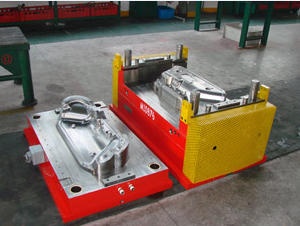
GMT compression molding involves high forming pressure. Tool structures must minimize deflection and maintain long-term dimensional accuracy.
High-strength tool steels, optimized rib layouts, and reinforced backing structures are commonly used to ensure durability.
Thermal control is the core of GMT tooling performance. Advanced GMT tools integrate:
For visible or functional parts, GMT tools must deliver smooth cavity surfaces, appropriate draft angles, and reliable demolding systems to ensure consistent quality.
| Aspect | GMT Tool | SMC Tool |
|---|---|---|
| Resin System | Thermoplastic | Thermoset |
| Forming Mechanism | Melting & Cooling | Chemical Curing |
| Cycle Time | Short | Longer |
| Recyclability | High | Limited |
GMT tools are essential for the efficient production of lightweight, durable, and recyclable thermoplastic composite components. Through precise thermal control, robust mold structures, and optimized cavity design, GMT compression tooling supports high-volume manufacturing without compromising performance.
As thermoplastic composites continue to expand across automotiveand industrial sectors, GMT tooling will remain a key technologyfor next-generation composite manufacturing.
Contact US
Email: master@zjmdc.com
Tel: +86 576 84616076
Fax: +86 576 84616079
Mobile: +86 13906573507(Mr. Wang)
Address: No.116 mochuang road, Huangyan Xinqian street,Taizhou,Zhejiang,China