
Specialize in Compression molds
Specialize in Compression molds
Manufacturing a large SMC mould requires more than an experienced mould design team. It also depends on suitable machining equipment, sufficient processing dimensions, reliable moulding presses, engineering coordination and the ability to manage heavy tooling throughout the production process.
For manufacturers developing large automotive components, industrial composite structures and other oversized SMC parts, the equipment available at a mould supplier directly influences manufacturing feasibility, machining efficiency and project execution.
MDC Mould combines composite mould manufacturing experience with a range of machining and moulding equipment. The company's manufacturing resources include CNC milling machines, drilling and deep drilling machines, spark erosion equipment, fitting machines and hydraulic presses. MDC has also successfully manufactured a mould with a net weight exceeding 120 tonnes.
This article examines the relationship between equipment capability and large SMC mould manufacturing, including machining dimensions, press capacity, mould heating options and the manufacturing considerations that buyers should evaluate when selecting a large composite mould manufacturer.
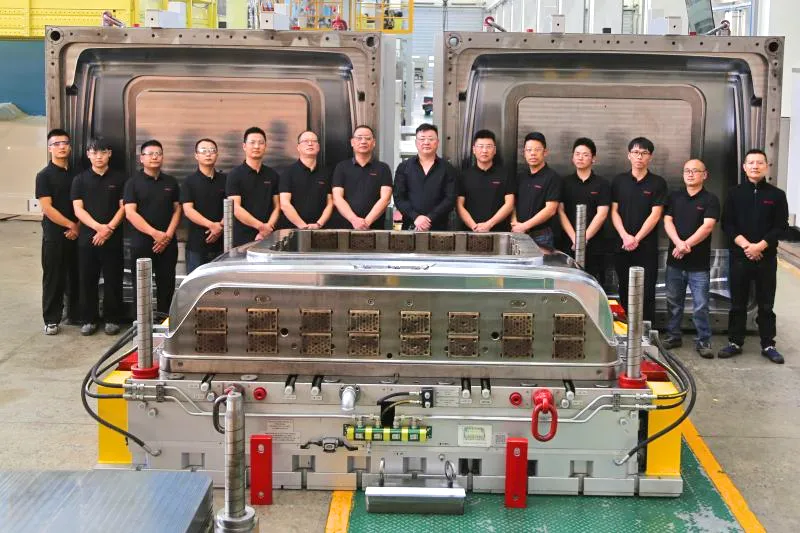
Large SMC moulds introduce manufacturing challenges that are not always present in conventional tooling projects. As mould dimensions and weight increase, the requirements for machining, handling, assembly and production testing become more demanding.
Several factors must be considered during the manufacturing process:
A supplier's ability to manufacture large tooling should therefore be evaluated through its actual equipment, machining resources and completed project experience rather than mould dimensions alone.
MDC's equipment resources cover several stages of composite mould manufacturing, from material removal and precision machining to mould assembly and production testing.
According to the company's equipment information, its manufacturing resources include high-speed CNC milling machines, CNC milling machines, drilling and deep drilling machines, spark erosion equipment, precision CNC machines, fitting machines and hydraulic presses.
| Equipment Category | Equipment Listed by MDC | Manufacturing Application |
|---|---|---|
| CNC Machining | High-speed CNC milling machines and CNC milling machines | Machining mould surfaces, cavities, profiles and structural components. |
| Deep-Hole Machining | Drilling and deep drilling machines | Producing specified holes and deep-hole features according to mould drawings. |
| Electrical Discharge Machining | Spark erosion machines | Machining geometries and features that require electrical discharge processing. |
| Precision Machining | CNC precision machines | Supporting dimensional machining requirements for mould components. |
| Mould Fitting | Fitting machines | Supporting mould fitting, assembly and related manufacturing operations. |
| Moulding and Testing | 500T, 1500T and 4000T press machines | Providing press resources for moulding-related operations and project testing, subject to press and mould compatibility. |
This equipment combination allows different machining and manufacturing operations to be coordinated within the mould production workflow. The specific machine and process used for each project depend on mould dimensions, component geometry, material requirements and machining specifications.
For more information about the company's manufacturing equipment, visit the MDC Mould Equipment page.
A moulding press is an important part of the composite mould manufacturing and validation environment. Its capacity, platen dimensions and heating configuration must be considered when evaluating whether a mould is suitable for a particular production process.
MDC's equipment page identifies a 4000T molding press with a platen size of 3600 mm × 2400 mm. The company also lists 500T and 1500T press machines within its equipment resources.
| Parameter | MDC Equipment Information | Engineering Relevance |
|---|---|---|
| Listed press capacities | 500T, 1500T and 4000T | Different press capacities provide options for different moulding and testing requirements. |
| 4000T press platen size | 3600 mm × 2400 mm | Provides a reference for evaluating mould installation dimensions and press compatibility. |
| Mould heating options | Hot oil, electric cartridge and steam heating | Allows heating configurations to be considered according to the mould design and production requirements. |
| Hydraulic cylinder brands listed | Parker, HPS, Merkle and SMC | Identifies hydraulic component brands used in the company's listed press equipment. |
Selecting a press for a large SMC mould is not determined by tonnage alone. Engineers must also evaluate the mould's overall dimensions, projected area, required closing force, installation height, opening stroke and production process.
The 3600 mm × 2400 mm platen size of MDC's listed 4000T press provides a useful reference for preliminary equipment evaluation. However, the actual usable installation area and project suitability should be confirmed against the press drawings and mould specifications.
A mould's maximum external dimensions should not automatically be treated as its compatible press dimensions. Clamping requirements, mould orientation, connection interfaces and operating clearances must also be reviewed.
MDC lists three mould heating options: hot oil, electric cartridge and steam heating. These are different heating approaches, and their suitability depends on the mould construction and the intended production process.
The heating method should be selected according to the material system, mould structure, production cycle and temperature requirements. Heating circuit design, sensor locations and temperature verification should be defined for each project rather than assumed to be identical across all moulds.
CNC machining is one of the most important stages in manufacturing large composite moulds. It determines how mould surfaces, cavities, parting areas and structural features are produced from the engineering design.
MDC has CNC machining resources including high-speed CNC milling machines and precision CNC equipment. The company also has experience with FIDIA five-axis CNC machining and a maximum machining envelope of approximately 6 × 4 m.
The machining envelope determines the maximum working dimensions that can be accommodated by a machine under its specified operating conditions. For large mould projects, this affects how components are divided, positioned and processed.
A machining envelope of approximately 6 × 4 m provides a useful reference when assessing large mould components. However, actual machinability also depends on component height, machine configuration, tool accessibility, workpiece weight and fixture arrangements.
For some large mould structures, the manufacturing plan may involve machining separate components before final assembly. The appropriate approach depends on the mould design and the dimensional relationships between individual sections.
Five-axis CNC machining provides additional tool-orientation flexibility compared with conventional three-axis machining. It can be useful when mould components contain inclined surfaces, complex profiles or geometries that require machining from different directions.
For composite mould manufacturing, the machining strategy should consider:
Five-axis capability does not mean every mould component must be machined in a single setup. The number of setups and machining sequence should be determined by the component geometry, machine working envelope and required accuracy.
Large composite moulds may contain holes, passages and geometrical features that cannot be efficiently produced through ordinary milling alone.
MDC lists drilling and deep drilling machines as well as spark erosion equipment. These processes provide additional manufacturing options for mould features that require dedicated machining methods.
The manufacturing method should be selected according to hole dimensions, depth-to-diameter ratio, material characteristics, geometry and drawing tolerances. Not every deep feature requires the same machining process.
Equipment specifications are important, but completed manufacturing projects provide another valuable reference when evaluating a large mould supplier.
MDC has successfully manufactured a mould with a net weight exceeding 120 tonnes. This represents practical experience in producing extremely heavy tooling and coordinating the manufacturing activities required for a large mould project.
A mould with a net weight exceeding 120 tonnes presents challenges across several manufacturing stages:
The net weight of a completed mould is not the same as a machine's lifting capacity, press capacity or machining capacity. These are separate engineering parameters and should be assessed independently.
| Engineering Dimension | Manufacturing Challenge | MDC Capability or Experience |
|---|---|---|
| Heavy Mould Manufacturing | Manufacturing and coordinating extremely heavy tooling structures. | Successfully manufactured a mould with a net weight exceeding 120 tonnes. |
| Large-Scale Machining | Machining large mould components with complex surface geometry. | FIDIA five-axis CNC machining experience and other CNC milling resources. |
| Machining Envelope | Accommodating oversized mould components. | Maximum machining envelope of approximately 6 × 4 m. |
| Drilling Operations | Producing specified holes and deep-hole features. | Drilling and deep drilling machines. |
| Specialized Machining | Producing geometries that require non-conventional machining. | Spark erosion equipment. |
| Press Resources | Evaluating moulding and testing requirements. | 500T, 1500T and 4000T presses; the listed 4000T press has a 3600 × 2400 mm platen. |
| Heating Options | Matching mould heating arrangements to project requirements. | Hot oil, electric cartridge and steam heating options. |
| Final Assembly | Coordinating mould fitting and component interfaces. | Fitting equipment and integrated manufacturing coordination. |
Large SMC mould manufacturing requires coordination between engineering design, machining, component inspection, assembly and testing. A well-planned workflow helps reduce inconsistencies between the original design and the finished tooling.
The process begins with an assessment of the product geometry, material requirements, mould structure and intended production conditions.
For large moulds, engineering planning should also consider overall dimensions, component segmentation, machining access, reference surfaces, press compatibility and the selected heating arrangement.
After the manufacturing plan is established, mould components are processed using suitable machining equipment. CNC milling, drilling, deep drilling and spark erosion may be used according to the geometry and manufacturing requirements.
Rough machining and finishing operations should be planned separately where necessary. Dimensional inspection at appropriate stages helps identify deviations before the components move to final fitting.
Large mould assembly involves more than placing individual components together. The relationship between mating surfaces, locating features, parting surfaces and alignment references must be checked.
The fitting stage is particularly important when a mould consists of multiple large components. Machining accuracy and assembly references need to work together to achieve the required final configuration.
Final testing should be based on the agreed project requirements. Depending on the mould and production process, verification may include dimensional checks, mould opening and closing checks, heating-system checks and trial moulding.
The actual testing plan should be agreed with the customer before production. Press availability, mould dimensions, material specifications and project-specific acceptance criteria all influence the testing arrangement.
When sourcing an extra-large SMC mould, buyers should look beyond general claims about factory size or equipment quantity. The following factors provide a more practical basis for supplier evaluation.
Ask for the machine working envelope and clarify whether the quoted dimensions refer to X, Y and Z travel, table size or a practical workpiece machining range. These values are not interchangeable.
Press tonnage alone is insufficient. Buyers should also review platen dimensions, mould installation height, opening stroke and other relevant press specifications.
Confirm whether the supplier can support the required heating method and whether the heating arrangement is compatible with the material system and production cycle.
For projects involving very heavy tooling, ask for relevant manufacturing references, mould photographs, overall dimensions and available project documentation. Completed project experience is more meaningful than an unsupported maximum-capacity claim.
A large mould project involves multiple connected operations. Buyers should understand how engineering, machining, fitting, inspection and testing are coordinated rather than evaluating each machine in isolation.
To evaluate a large SMC mould project efficiently, buyers should provide as much technical information as possible at the quotation stage.
| Required Information | Recommended Details | Why It Matters |
|---|---|---|
| Product Drawings | 3D models, 2D drawings and critical dimensions. | Establishes product geometry and tooling design requirements. |
| Product Material | SMC grade, material specification and relevant processing information. | Influences mould design and production conditions. |
| Estimated Mould Dimensions | Overall length, width and height. | Supports preliminary machining and press compatibility assessment. |
| Estimated Mould Weight | Expected total mould weight, if available. | Helps evaluate manufacturing and handling arrangements. |
| Press Information | Available press tonnage, platen dimensions and installation limits. | Helps determine whether the mould can be installed and operated on the intended press. |
| Heating Requirements | Hot oil, electric cartridge, steam or other specified requirements. | Supports heating-system planning. |
| Production Requirements | Annual volume, target cycle time and expected production life. | Helps define the appropriate tooling configuration. |
| Acceptance Criteria | Critical tolerances, surface requirements and inspection standards. | Defines the basis for manufacturing verification and project acceptance. |
Providing these details allows the mould manufacturer to assess the project more accurately and identify potential manufacturing constraints before detailed engineering begins.
MDC Mould specializes in composite mould manufacturing, including SMC, BMC, GMT, LFT and other composite tooling applications.
The company's equipment resources include CNC milling machines, drilling and deep drilling machines, spark erosion equipment, precision CNC machines, fitting machines and hydraulic presses. Its listed press resources include 500T, 1500T and 4000T machines, with the 4000T press featuring a 3600 mm × 2400 mm platen.
MDC also has experience with FIDIA five-axis CNC machining and a maximum machining envelope of approximately 6 × 4 m. Its completed manufacturing experience includes a mould with a net weight exceeding 120 tonnes.
For large composite tooling projects, the combination of equipment resources, machining experience and coordinated manufacturing processes provides a practical foundation for evaluating project feasibility.
Whether the requirement involves a large SMC mould, heavy composite tooling or a complex multi-component mould structure, the first step is to review the product drawings, mould dimensions, material requirements and intended production conditions.
Buyers should evaluate actual machining dimensions, CNC equipment, press capacity, platen size, heating options, heavy mould manufacturing experience, assembly resources and the supplier's ability to coordinate the complete manufacturing workflow.
MDC has successfully manufactured a mould with a net weight exceeding 120 tonnes. This is a completed manufacturing reference and should not be interpreted as the lifting capacity or press capacity of a particular machine.
MDC's equipment page lists 500T, 1500T and 4000T press machines. The listed 4000T molding press has a platen size of 3600 mm × 2400 mm. Final press suitability depends on the mould and production requirements.
MDC lists hot oil, electric cartridge and steam heating options. The appropriate configuration depends on the mould design, material system and production requirements.
MDC has experience with FIDIA five-axis CNC machining. The company's maximum machining envelope is approximately 6 × 4 m. Actual component machinability depends on geometry, workpiece dimensions, machine configuration and setup requirements.
Mould weight alone cannot determine press compatibility. The mould's external dimensions, installation height, projected area, required closing force and handling arrangements must be evaluated separately. The available press specifications and project requirements should be reviewed before confirming a testing plan.
Buyers should provide product drawings, 3D models, SMC material information, estimated mould dimensions and weight, press specifications, heating requirements, production volume and acceptance criteria.
Large composite tooling requires more than conventional mould manufacturing resources. It demands suitable machining equipment, engineering coordination, appropriate press resources and experience in managing heavy mould structures.
MDC Mould has successfully manufactured moulds exceeding 120 tonnes in net weight. Its manufacturing resources include FIDIA five-axis CNC machining experience, an approximately 6 × 4 m maximum machining envelope, CNC milling and drilling equipment, fitting machines and hydraulic presses up to 4000T.
The company also lists hot oil, electric cartridge and steam heating options for moulding applications.
If you are developing a large SMC mould or heavy composite tooling project, send MDC your product drawings, estimated mould dimensions, weight and production requirements for an initial technical review.
Contact MDC Mould: master@zjmdc.com
Equipment information: MDC Mould Manufacturing Equipment
Contact US
Email: master@zjmdc.com
Tel: +86 576 84616076
Fax: +86 576 84616079
Mobile: +86 13906573507(Mr. Wang)
Address: No.116 mochuang road, Huangyan Xinqian street,Taizhou,Zhejiang,China