
Specialize in Compression molds
Specialize in Compression molds
Carbon fiber composites are widely used in aerospace, automotive, energy, sports equipment, and industrial applications because of their exceptional strength-to-weight ratio, corrosion resistance, and design flexibility. However, producing high-quality carbon fiber components requires far more than selecting premium materials. The accuracy of the carbon fiber mould plays a decisive role in determining dimensional precision, surface finish, structural integrity, and production consistency.
Modern composite manufacturing demands increasingly tighter tolerances and higher cosmetic standards. Whether components are produced through compression molding, resin transfer molding (RTM), vacuum infusion, or prepreg processing, the mould serves as the foundation of the entire manufacturing process. Even minor tooling deviations can affect laminate quality, curing consistency, and final assembly performance.
At MDC, we specialize in designing and manufacturing precision carbon fiber moulds for demanding composite applications. By combining advanced CNC machining, precision polishing, optimized venting, and robust mould structures, we help manufacturers achieve stable production, excellent repeatability, and long service life.
Unlike conventional plastic components, carbon fiber composite parts often function as structural elements that must withstand high mechanical loads while maintaining strict dimensional accuracy. Small variations in mould geometry can directly influence fiber orientation, resin distribution, laminate thickness, and bonding quality.
For industries such as aerospace and automotive manufacturing, dimensional deviations of only a fraction of a millimeter may lead to assembly difficulties, increased finishing work, or even product rejection. Therefore, mould precision is not simply a quality requirement—it is a key factor affecting production efficiency and component reliability.
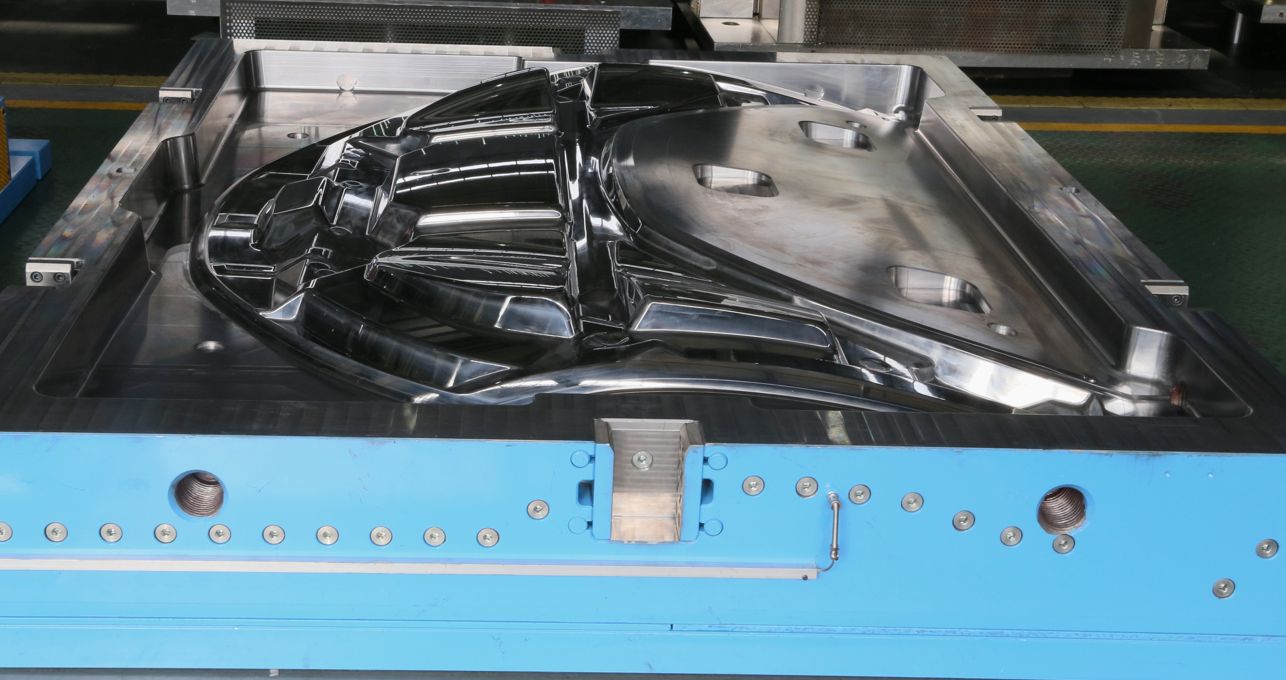
A high-performance carbon fiber mould is much more than a cavity that defines part geometry. Every design feature—including cavity accuracy, structural rigidity, draft angles, heating channels, and venting systems—affects how composite materials behave during the molding cycle.
Precision machining ensures that every contour, radius, and mating surface conforms to engineering drawings. Accurate mould geometry reduces assembly variation and supports the production of complex composite structures with consistent dimensions.
During compression molding or autoclave curing, moulds experience significant thermal and mechanical loads. A rigid mould structure minimizes deformation, maintains cavity accuracy, and preserves long-term production stability.
Proper draft angles facilitate smooth demoulding while protecting delicate composite surfaces from scratches, cracks, or edge damage. Optimized draft design also reduces production downtime and extends mould service life.
The surface quality of the mould is directly transferred to the finished carbon fiber component. Even microscopic imperfections on the mould surface may appear on high-gloss composite parts, increasing finishing work and reducing product quality.
Depending on application requirements, mould cavities may undergo precision polishing to achieve mirror-quality surfaces or engineered textures. A properly finished mould offers several manufacturing advantages:
The manufacturing quality of a carbon fiber mould begins with precision machining. High-performance composite parts often require tight dimensional tolerances and complex geometries that can only be achieved through advanced CNC machining technology. Every contour, cavity, and mating surface must be manufactured with exceptional accuracy to ensure that the finished composite component matches its design specifications.
Modern multi-axis CNC machining centers allow engineers to produce complex mould surfaces with excellent repeatability while minimizing machining errors. Combined with precision EDM, grinding, and manual fitting, these processes ensure that each mould component fits together accurately throughout the production cycle.
High machining accuracy delivers several important benefits:
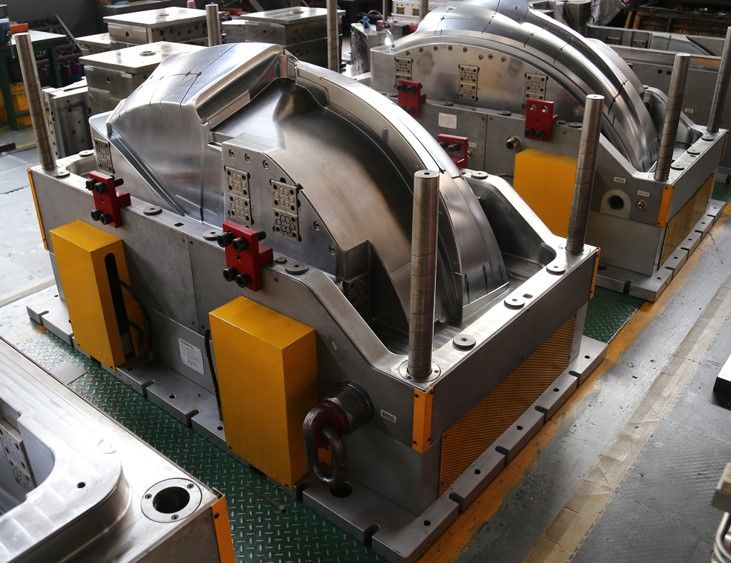
Carbon fiber composites are highly sensitive to curing temperature. Whether using prepreg materials, compression molding compounds, or resin infusion systems, the mould must provide stable and uniform thermal conditions throughout the curing cycle. Uneven temperatures can lead to inconsistent resin flow, incomplete curing, residual stress, and dimensional distortion.
A properly engineered mould incorporates balanced heating channels and optimized thermal distribution to minimize temperature variations across the cavity surface. Maintaining thermal stability improves curing consistency while reducing the risk of warpage and internal defects.
During carbon fiber molding, trapped air and volatile gases must be removed from the mould cavity before the resin fully cures. Without an effective venting system, air pockets may remain inside the laminate, creating voids that reduce structural strength and negatively affect surface quality.
Engineers carefully position venting features to allow gases to escape while preventing excessive resin loss. Proper venting is particularly important for complex geometries and thick composite laminates where airflow paths are more restricted.
An optimized venting system helps manufacturers reduce:
For many advanced composite manufacturing processes, vacuum assistance is used to remove air from the laminate before curing. The mould must provide excellent sealing performance to maintain stable vacuum pressure throughout the process.
Leakage around mould parting surfaces or sealing grooves can reduce vacuum efficiency, allowing air to remain inside the laminate. This may result in porosity, inconsistent fiber consolidation, and reduced mechanical performance.
Precision-machined sealing surfaces and properly designed gasket systems help ensure stable vacuum conditions, producing composite parts with improved density, strength, and cosmetic appearance.
Tool material selection influences machining performance, thermal conductivity, durability, and overall production cost. The most suitable material depends on production volume, mould size, processing temperature, and surface quality requirements.
| Tool Material | Advantages | Typical Applications |
|---|---|---|
| P20 Tool Steel | Cost-effective with good machinability | Prototype and medium-volume production |
| H13 Tool Steel | Excellent thermal fatigue resistance | High-volume compression molding |
| Aluminum Alloy | High thermal conductivity and lightweight | Prototype tools and low-volume composite production |
| Invar | Extremely low thermal expansion | Aerospace composite tooling requiring exceptional dimensional stability |
Material selection should always balance production requirements, expected tool life, manufacturing efficiency, and total lifecycle cost rather than focusing solely on initial tooling investment.
Even with advanced composite materials and automated production equipment, tooling quality remains one of the primary factors influencing manufacturing success. Identifying potential mould-related issues early allows manufacturers to reduce production risks and improve long-term process stability.
| Manufacturing Challenge | Possible Cause | Recommended Solution |
|---|---|---|
| Dimensional Deviation | Insufficient machining accuracy or mould deformation | Improve CNC precision and increase mould rigidity |
| Surface Imperfections | Poor polishing or cavity contamination | Optimize polishing processes and regular mould cleaning |
| Voids and Porosity | Inadequate venting or vacuum leakage | Improve vent design and sealing performance |
| Resin Accumulation | Improper cavity geometry or uneven pressure | Optimize mould design and molding parameters |
| Difficult Demoulding | Insufficient draft angle or worn mould surfaces | Refine draft design and maintain cavity finish |
| Warping After Curing | Uneven temperature distribution or residual stress | Improve thermal balance and controlled cooling |
Addressing these issues through engineering-focused mould design helps manufacturers improve product consistency, reduce material waste, and achieve reliable long-term composite production.
As composite materials continue to replace traditional metals in high-performance engineering, precision carbon fiber moulds are becoming essential across a wide range of industries. Lightweight design, excellent mechanical properties, and design flexibility have accelerated the adoption of carbon fiber composites in applications where dimensional accuracy and structural integrity are critical.
High-quality tooling ensures that complex composite components can be manufactured with consistent dimensions, reliable mechanical performance, and excellent surface finish, even during high-volume production.
The aerospace industry demands exceptional dimensional precision and repeatability. Carbon fiber moulds are widely used to manufacture aircraft interior panels, structural reinforcements, fairings, radomes, and other lightweight composite components where weight reduction contributes directly to fuel efficiency and payload capacity.
Automotive manufacturers increasingly rely on carbon fiber composites to reduce vehicle weight while maintaining strength and safety. Precision moulds support the production of body panels, battery enclosures, aerodynamic parts, and structural reinforcements with consistent quality.
Carbon fiber composites are widely used in hydrogen storage systems and new energy equipment because of their excellent strength-to-weight ratio and corrosion resistance. Precision tooling supports the production of composite structures that require strict dimensional control and long-term reliability.
Manufacturers of bicycles, racing equipment, marine products, and sporting goods rely on precision moulds to produce lightweight carbon fiber components with attractive cosmetic finishes and excellent mechanical performance.
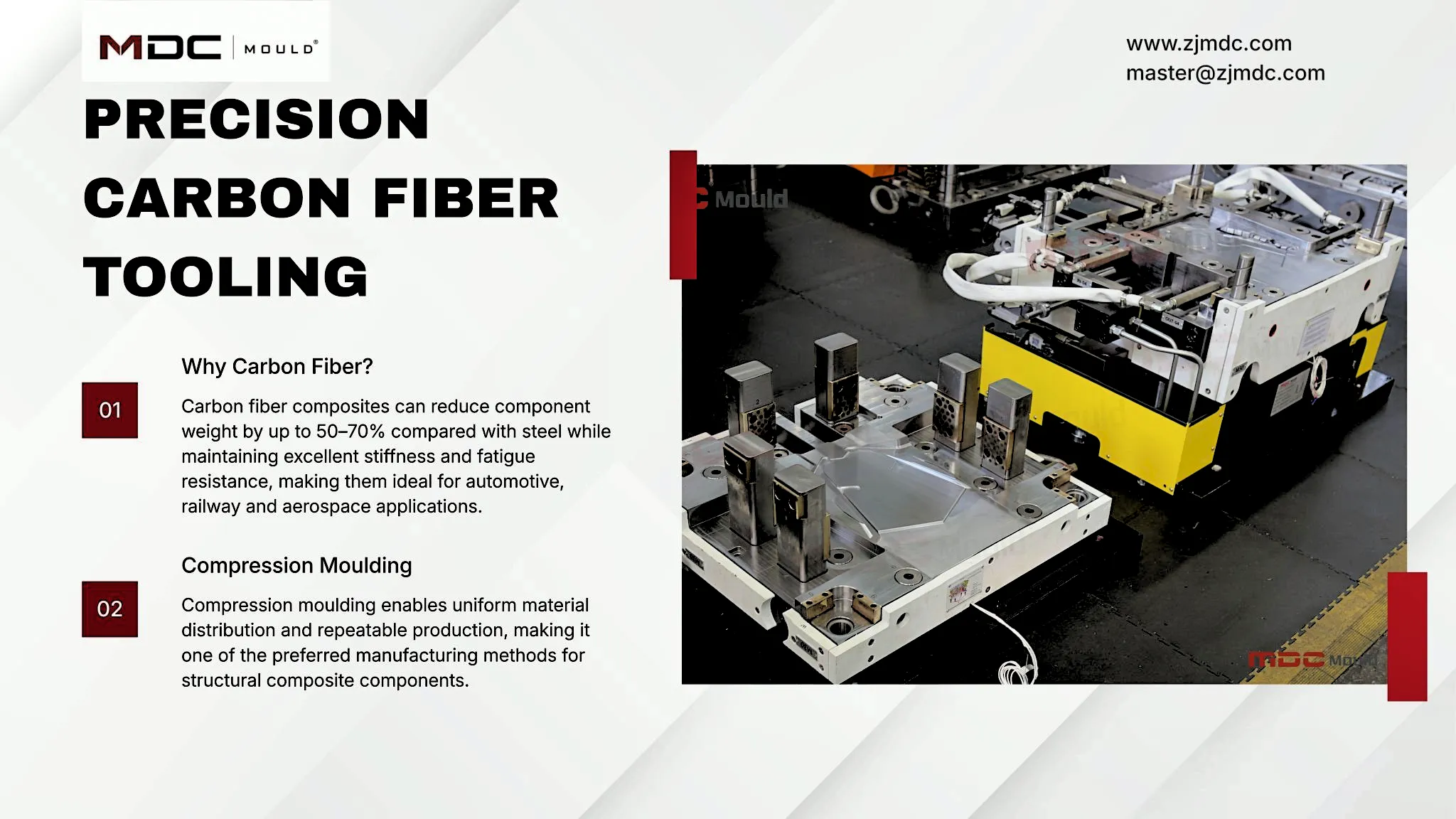
At MDC, every carbon fiber mould is developed through a structured engineering process that combines advanced design software, precision machining technology, and comprehensive quality control. Our objective is to deliver tooling that performs reliably throughout its entire production lifecycle while supporting consistent composite part quality.
Each project begins with an engineering evaluation of the customer's product drawings, composite material system, molding process, and production targets. Design for Manufacturability (DFM) analysis helps optimize cavity design, mould structure, and production efficiency before manufacturing begins.
High-speed CNC machining centers are used to manufacture complex mould cavities with exceptional dimensional accuracy. Precision milling is combined with EDM, grinding, and manual fitting to ensure accurate assembly and smooth cavity transitions.
The mould surface is polished according to customer requirements, ranging from engineering-grade finishes to mirror-quality surfaces for visible composite components. High-quality polishing improves demoulding performance while enhancing the appearance of finished parts.
After machining, every mould is assembled, inspected, and tested to verify cavity alignment, sealing performance, and functional accuracy. Trial production helps confirm that the mould performs as expected before delivery.
Maintaining consistent mould quality requires systematic inspection throughout every manufacturing stage. Rather than relying solely on final inspection, MDC integrates quality verification into the complete production workflow.
| Manufacturing Stage | Inspection Focus |
|---|---|
| Raw Material Inspection | Steel certification, hardness, and material verification |
| CNC Machining | Critical dimensions, cavity geometry, and machining tolerances |
| Component Fitting | Assembly accuracy and alignment verification |
| Surface Finishing | Polishing quality and cavity surface condition |
| Functional Testing | Trial molding, dimensional verification, and production evaluation |
| Final Inspection | Compliance with customer drawings and technical specifications |
This structured quality management approach minimizes production risks and helps ensure that every mould delivers reliable performance throughout long-term manufacturing.
Choosing a reliable tooling partner is just as important as selecting advanced composite materials. Precision mould manufacturing requires engineering expertise, machining capability, and a deep understanding of composite production processes.
MDC provides customized carbon fiber tooling solutions for customers worldwide, supporting applications from prototype development to high-volume manufacturing. Every project is engineered to improve production efficiency, reduce manufacturing variation, and maximize long-term tooling performance.
Whether your project involves aerospace structures, lightweight automotive components, hydrogen energy systems, or industrial composite products, MDC is committed to delivering precision carbon fiber moulds engineered for accuracy, durability, and long-term production reliability.
A carbon fiber mould is a precision tool used to manufacture carbon fiber composite components through processes such as compression molding, prepreg lay-up, resin transfer molding (RTM), vacuum infusion, and autoclave curing. The mould determines the final shape, dimensional accuracy, surface finish, and production consistency of every composite part.
Carbon fiber components are often used in structural applications where tight tolerances are essential. High mould accuracy helps maintain laminate thickness, improve assembly precision, reduce secondary machining, and ensure consistent mechanical performance throughout production.
The most common mould materials include P20 tool steel, H13 tool steel, aluminum alloys, and Invar. The selection depends on production volume, curing temperature, required dimensional stability, and expected mould life. Aerospace applications often use Invar because of its extremely low coefficient of thermal expansion.
The cavity surface of the mould is directly replicated on the finished composite part. A high-quality polished surface improves cosmetic appearance, reduces release resistance, minimizes finishing work, and supports stable production quality.
Effective venting removes trapped air and gases during the molding process. Proper vent design reduces voids, pinholes, dry fiber areas, and other internal defects while improving laminate consolidation and overall structural integrity.
Yes. Carbon fiber moulds are typically custom-designed according to part geometry, manufacturing process, composite material system, production volume, and customer quality requirements. Each project requires a tailored engineering solution to achieve the desired performance.
Tool life depends on mould material, production conditions, maintenance practices, and manufacturing quality. With appropriate tool steel selection, precision machining, and preventive maintenance, a carbon fiber mould can support long-term, high-volume production while maintaining dimensional accuracy.
MDC follows a complete manufacturing workflow that includes DFM analysis, precision CNC machining, EDM processing, assembly inspection, cavity polishing, dimensional verification, and trial molding. Quality control is performed throughout the manufacturing process to ensure stable tooling performance.
Precision carbon fiber moulds are widely used in aerospace, automotive, electric vehicles, hydrogen energy systems, rail transportation, marine engineering, sports equipment, medical devices, and industrial composite manufacturing.
MDC combines extensive experience in composite tooling, precision machining, thermal control design, and quality management to manufacture customized carbon fiber moulds that deliver excellent dimensional accuracy, long service life, and stable production performance.
As carbon fiber composites continue to replace traditional materials in lightweight engineering, the demand for precision tooling has never been greater. While advanced fibers and resin systems provide outstanding mechanical performance, the quality of the final component ultimately depends on the engineering accuracy of the mould.
A well-designed carbon fiber mould does more than define part geometry. It controls dimensional accuracy, fiber consolidation, thermal stability, surface quality, resin flow, and production repeatability. These factors work together to reduce manufacturing defects, improve process efficiency, and ensure reliable long-term product performance.
At MDC, we combine engineering expertise, advanced CNC machining, precision surface finishing, optimized thermal management, and comprehensive quality control to manufacture high-performance carbon fiber moulds for customers worldwide. Every tooling project is developed with a focus on precision, durability, and manufacturing efficiency.
Whether you are developing lightweight automotive components, aerospace structures, hydrogen energy systems, or other advanced composite products, MDC is committed to providing customized carbon fiber mould solutions that support reliable production and long-term manufacturing success.
Contact US
Email: master@zjmdc.com
Tel: +86 576 84616076
Fax: +86 576 84616079
Mobile: +86 13906573507(Mr. Wang)
Address: No.116 mochuang road, Huangyan Xinqian street,Taizhou,Zhejiang,China