
Specialize in Compression molds
Specialize in Compression molds
As the global automotive industry accelerates toward lightweight vehicle design, composite leaf springs have become an increasingly attractive alternative to conventional steel springs. Their outstanding strength-to-weight ratio, corrosion resistance, fatigue durability, and design flexibility enable vehicle manufacturers to reduce overall weight while maintaining excellent load-bearing performance and driving stability.
Producing high-quality composite leaf springs requires more than advanced composite materials. The performance, dimensional consistency, and production efficiency of every component depend heavily on the precision of the composite leaf spring mould. A well-engineered compression mould ensures uniform material flow, balanced curing, accurate fiber consolidation, and stable mechanical properties throughout every production cycle.
At MDC, we specialize in designing and manufacturing customized compression moulds for composite leaf springs used in commercial vehicles, passenger cars, buses, specialty vehicles, and other lightweight transportation applications. Every mould is engineered with a focus on machining precision, structural rigidity, thermal balance, and long-term production reliability to help customers achieve consistent product quality and efficient mass production.
A composite leaf spring is a suspension component manufactured from fiber-reinforced composite materials rather than traditional spring steel. Depending on the application, reinforcement materials may include glass fiber, carbon fiber, or hybrid fiber systems combined with thermosetting resin matrices such as epoxy, vinyl ester, or polyester resin.
Unlike conventional multi-leaf steel springs, composite leaf springs are typically manufactured as a single-piece structure through compression molding or other composite forming processes. This integrated design reduces component weight while maintaining excellent stiffness, fatigue resistance, and long-term durability.
Composite leaf springs are increasingly adopted in electric vehicles, commercial trucks, buses, pickup trucks, agricultural machinery, military vehicles, and high-performance transportation systems where lightweight construction contributes directly to improved fuel efficiency or extended battery range.
Vehicle manufacturers are continuously seeking solutions that reduce weight without compromising safety or durability. Composite leaf springs provide several significant advantages compared with conventional steel springs, making them an ideal choice for modern lightweight vehicle platforms.
For electric vehicles, reducing suspension weight contributes directly to improved energy efficiency and extended driving range. For commercial trucks and buses, lighter suspension systems increase payload capacity while lowering operating costs.
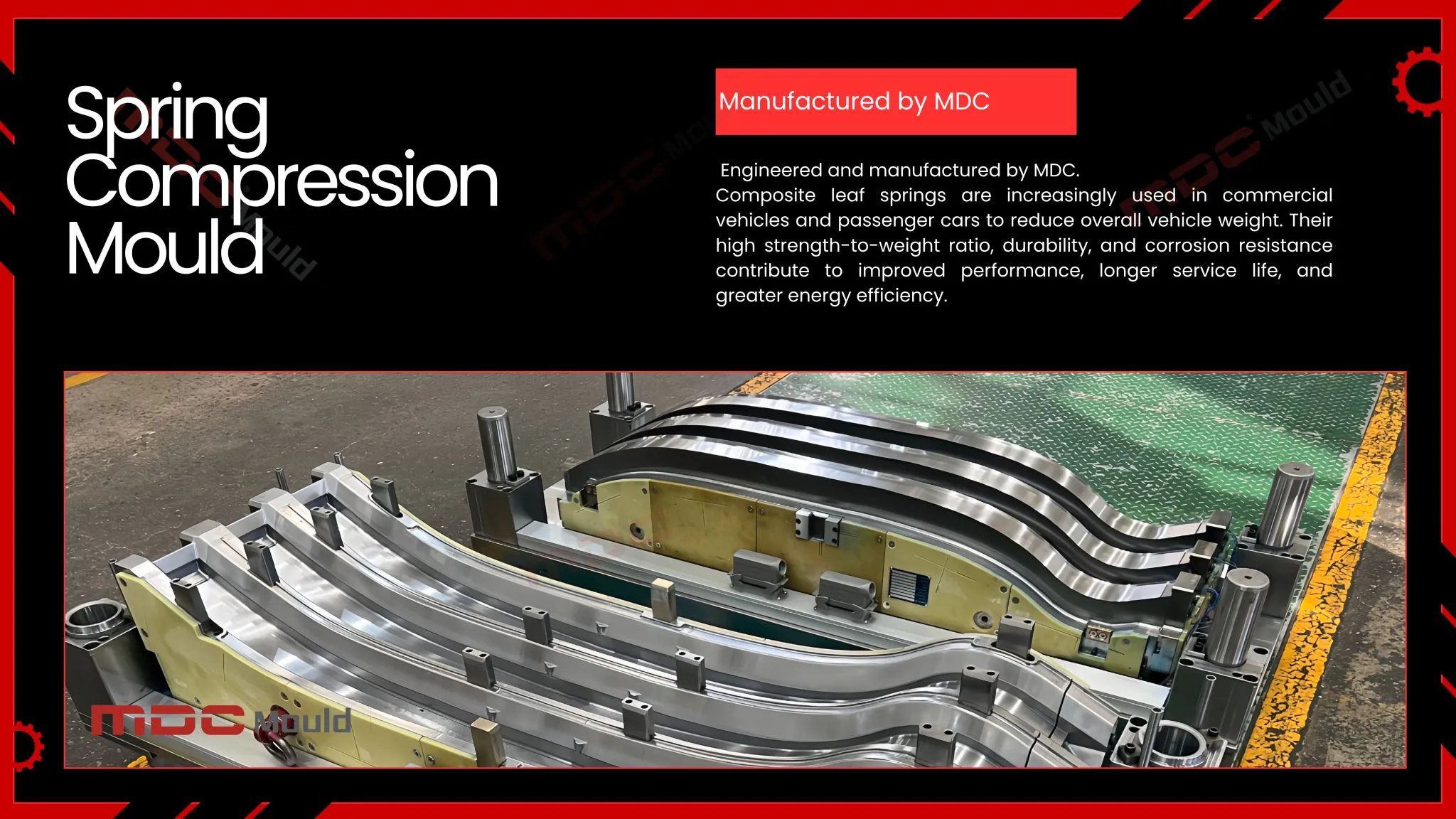
The quality of a composite leaf spring is determined not only by the material system but also by the engineering quality of the mould. During compression molding, the mould controls fiber positioning, resin flow, curing temperature, pressure distribution, and final dimensional accuracy.
Even premium composite materials cannot compensate for an improperly designed mould. Uneven heating, insufficient rigidity, or poor cavity accuracy may result in inconsistent thickness, internal voids, fiber distortion, residual stress, or premature product failure.
A precision-engineered composite leaf spring mould helps manufacturers achieve stable production, high repeatability, reduced scrap rates, and consistent mechanical performance throughout long production runs.
Compression molding is one of the most widely adopted manufacturing methods for composite leaf springs because it combines excellent dimensional accuracy with high production efficiency. The process allows reinforced composite materials to cure under controlled temperature and pressure, producing structural components with outstanding mechanical properties.
Stable temperature control, balanced pressure distribution, and accurate mould alignment are essential throughout the molding cycle to ensure consistent product quality and long-term production reliability.
Designing a high-performance composite leaf spring mould requires far more than creating the correct cavity shape. The mould must control fiber consolidation, resin flow, temperature distribution, pressure transmission, and dimensional stability throughout the entire compression molding cycle. Every engineering decision directly affects product performance, manufacturing efficiency, and tooling life.
Because composite leaf springs are structural safety components, manufacturers demand excellent repeatability from every production cycle. A properly engineered mould ensures that each leaf spring meets strict requirements for thickness, curvature, stiffness, and fatigue performance.
The mould cavity defines the final profile of the composite leaf spring. Smooth transitions, accurate radii, and carefully designed thickness variations help ensure uniform material flow during compression while minimizing internal stress concentrations after curing.
During compression molding, pressure must be transmitted evenly across the entire laminate. Uneven pressure can lead to resin-rich zones, dry fiber areas, inconsistent thickness, and localized reductions in mechanical strength. Proper mould structure and press alignment help maintain stable pressure throughout the curing cycle.
Composite leaf spring moulds are subjected to significant clamping forces during production. A rigid mould structure minimizes deformation under load, maintains cavity accuracy, and improves long-term production consistency. For large moulds, structural analysis is often performed during the design stage to optimize stiffness without unnecessary weight.
Repeated heating and cooling cause every mould to expand and contract. Engineers must consider the thermal expansion characteristics of both the tooling material and the composite laminate to maintain dimensional accuracy throughout long production runs.
Temperature control is one of the most critical factors affecting composite leaf spring quality. The heating system must deliver consistent thermal energy across the entire mould surface so that every section of the laminate cures under nearly identical conditions.
If one area of the mould reaches curing temperature earlier than another, the resin may gel prematurely, restricting material flow and creating residual stresses. These stresses can reduce fatigue life and cause dimensional variation after demoulding.
Depending on customer requirements and production capacity, composite leaf spring moulds may use electric cartridge heaters, heating plates, thermal oil circulation, or other controlled heating systems. Regardless of the method, the objective remains the same: maintaining a stable and uniform mould temperature.
Tool steel selection has a direct influence on mould durability, machining accuracy, maintenance frequency, and production cost. The optimal material depends on production volume, mould size, curing temperature, and customer quality requirements.
| Tool Steel | Key Advantages | Recommended Applications |
|---|---|---|
| P20 | Good machinability and economical cost | Prototype tooling and medium-volume production |
| 718 | Higher hardness with excellent polishability | Automotive composite moulds |
| H13 | Outstanding thermal fatigue resistance | High-volume compression molding |
| S136 | Excellent corrosion resistance and mirror finishing | High-precision composite products |
In addition to selecting the proper steel grade, appropriate heat treatment is essential for achieving stable hardness, minimizing distortion, and extending mould service life under repeated thermal cycles.
The machining quality of a composite leaf spring mould determines its dimensional accuracy, cavity consistency, and production repeatability. Modern CNC machining technology enables manufacturers to produce complex mould geometries while maintaining tight tolerances throughout the entire cavity.
After rough machining, precision milling, EDM, grinding, and manual fitting are performed to achieve the required accuracy. Surface polishing is then carried out according to product requirements to improve part appearance and facilitate smooth demoulding.
High-quality surface finishing provides several production advantages:
Although composite leaf spring manufacturing has become increasingly mature, several technical challenges remain. Identifying the root causes of production issues allows engineers to improve process stability while reducing scrap and maintenance costs.
| Challenge | Primary Cause | Engineering Solution |
|---|---|---|
| Thickness Variation | Uneven pressure or cavity deviation | Optimize mould alignment and pressure distribution |
| Resin-Rich Areas | Improper material placement | Improve preform design and mould cavity balance |
| Voids and Porosity | Entrapped air during molding | Optimize venting and curing parameters |
| Springback | Residual thermal stress | Improve temperature uniformity and cooling control |
| Surface Marks | Poor mould finish or contamination | Improve polishing quality and routine mould maintenance |
| Difficult Demoulding | Insufficient draft angle or improper release conditions | Optimize mould design and release agent application |
Addressing these challenges during the mould design stage is significantly more effective than correcting defects after production has started. A combination of sound engineering, precision machining, and controlled molding parameters provides the foundation for reliable, high-volume manufacturing.
As vehicle manufacturers continue to pursue lightweight engineering and improved energy efficiency, composite leaf springs are being adopted across an expanding range of transportation applications. Compared with traditional steel suspension systems, composite leaf springs provide significant weight savings while maintaining excellent structural performance, fatigue resistance, and long-term durability.
Precision composite leaf spring moulds enable manufacturers to produce suspension components with consistent mechanical properties, accurate dimensions, and reliable production repeatability. Today, these moulds are widely used in both conventional and new-energy vehicle manufacturing.
Commercial vehicles require suspension systems capable of carrying heavy loads while operating under demanding road conditions. Composite leaf springs help reduce vehicle weight without sacrificing load capacity, improving fuel efficiency and increasing available payload.
Passenger car manufacturers are increasingly replacing steel suspension components with composite alternatives to reduce vehicle mass and improve driving efficiency. Lower unsprung weight also contributes to improved ride comfort and vehicle handling.
Every kilogram removed from an electric vehicle contributes to improved energy efficiency and extended driving range. Composite leaf springs support lightweight vehicle architecture while maintaining the structural reliability required for long-term operation.
Composite suspension technology is also suitable for agricultural machinery, military vehicles, off-road equipment, and specialty transportation systems where corrosion resistance, durability, and weight reduction are equally important.
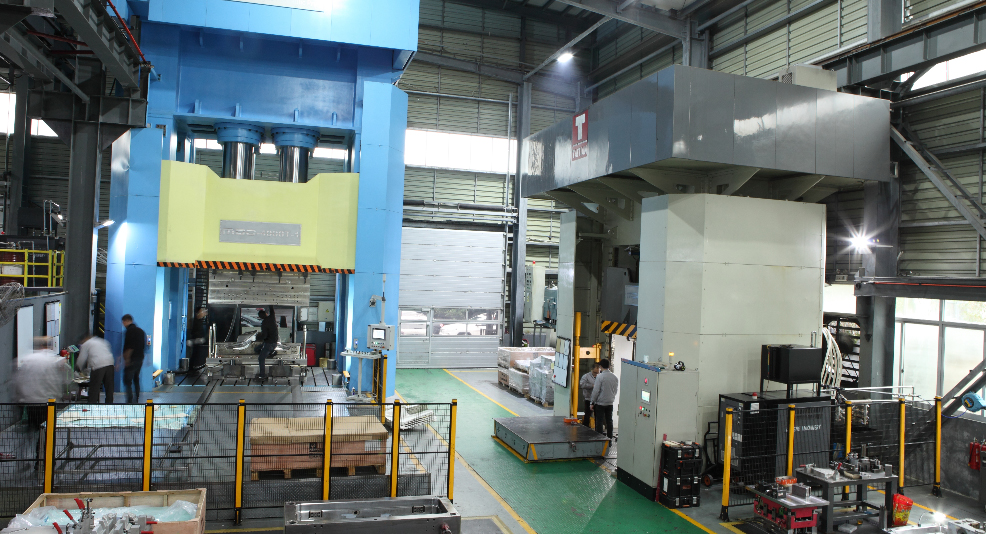
Manufacturing a high-quality composite leaf spring mould requires a combination of engineering expertise, precision machining, and rigorous quality management. At MDC, every mould is developed with the objective of delivering stable production, long service life, and consistent product quality throughout thousands of molding cycles.
From the initial design review to final mould testing, every stage follows standardized engineering procedures to ensure reliable performance in demanding production environments.
Each project begins with a detailed analysis of the customer's product drawings, composite material selection, production volume, and molding process. Design for Manufacturability (DFM) reviews help optimize mould structure before manufacturing starts.
Advanced CNC machining centers are used to manufacture mould components with high dimensional accuracy. Precision milling, EDM, grinding, and manual fitting ensure that every cavity meets strict engineering requirements.
Heating channels are carefully designed to provide uniform temperature distribution across the mould surface. Balanced thermal performance improves curing consistency while reducing residual stress and dimensional variation.
Before delivery, moulds are assembled, inspected, and trial-tested to verify dimensional accuracy, product appearance, and molding performance. Any necessary adjustments are completed before shipment to help customers achieve a faster production start-up.
Reliable quality control is essential for producing precision compression moulds. At MDC, inspection is integrated into every manufacturing stage rather than being limited to the final acceptance process.
| Manufacturing Stage | Quality Control Focus |
|---|---|
| Raw Material Inspection | Verify tool steel grade, hardness, and material certification |
| CNC Machining | Monitor dimensional accuracy and machining tolerances |
| Heat Treatment | Control hardness and minimize thermal distortion |
| Component Assembly | Check alignment, fitting accuracy, and structural integrity |
| Surface Finishing | Inspect polishing quality and cavity appearance |
| Trial Molding | Validate molding performance and finished part quality |
| Final Inspection | Confirm dimensions, documentation, and customer specifications |
This systematic quality management approach helps reduce production risks, improve mould reliability, and provide customers with tooling that performs consistently under continuous manufacturing conditions.
Selecting the right mould manufacturer is a key factor in the success of any composite leaf spring project. Beyond machining capability, an experienced tooling partner should understand composite materials, compression molding technology, tooling durability, and the production challenges associated with structural automotive components.
With extensive experience in compression mould and composite mould manufacturing, MDC supplies customized tooling solutions for customers worldwide. Every project is developed with careful attention to engineering accuracy, production efficiency, and long-term mould performance.
Whether you are developing lightweight suspension systems for commercial vehicles or advanced composite components for passenger cars, MDC is committed to delivering precision mould solutions that help improve manufacturing efficiency, product consistency, and long-term production reliability.
The global automotive industry is undergoing a fundamental transformation driven by vehicle electrification, stricter emissions regulations, and increasing demand for lightweight engineering. Every kilogram removed from a vehicle contributes to improved fuel economy, lower emissions, or extended driving range. As a result, manufacturers are replacing conventional steel components with advanced composite materials wherever practical.
Among suspension components, composite leaf springs represent one of the most effective opportunities for weight reduction. Compared with traditional multi-leaf steel springs, composite designs combine lower mass with outstanding fatigue resistance, corrosion resistance, and design flexibility, making them increasingly attractive for both commercial and passenger vehicles.
| Comparison | Composite Leaf Spring | Traditional Steel Leaf Spring |
|---|---|---|
| Weight | Up to 60–70% lighter | Heavier |
| Corrosion Resistance | Excellent | Requires protective coating |
| Fatigue Performance | Excellent under repeated loading | Good but susceptible to fatigue cracking |
| Noise & Vibration | Better vibration damping | Higher noise transmission |
| Maintenance | Lower maintenance requirements | Regular inspection and corrosion protection |
| Design Flexibility | High | Limited by steel forming |
These advantages make composite leaf springs particularly suitable for electric vehicles, commercial trucks, buses, and specialty vehicles where lightweight construction directly improves operating efficiency and payload capacity.
A composite leaf spring mould is a precision compression mould used to manufacture fiber-reinforced composite leaf springs under controlled temperature and pressure. It determines the final shape, thickness, dimensional accuracy, and mechanical consistency of the finished suspension component.
Composite leaf springs are commonly produced using glass fiber, carbon fiber, or hybrid fiber reinforcements combined with thermosetting resin systems such as epoxy, vinyl ester, or polyester resin.
Compression molding provides excellent fiber consolidation, high dimensional accuracy, short production cycles, and consistent product quality, making it one of the most efficient manufacturing methods for structural composite suspension components.
A precision mould ensures uniform pressure, balanced curing temperatures, accurate laminate thickness, and consistent fiber distribution. These factors directly influence fatigue life, load capacity, dimensional stability, and long-term reliability.
P20, 718, H13, and S136 tool steels are widely used depending on production volume, curing temperature, polishing requirements, and expected mould service life.
Composite leaf spring moulds are widely used in commercial vehicles, passenger cars, electric vehicles, buses, agricultural machinery, military vehicles, and specialty transportation equipment.
Yes. Every mould can be customized according to the customer's product geometry, composite material, production capacity, press specifications, and quality requirements.
MDC combines engineering expertise, precision CNC machining, optimized heating system design, strict quality control, and extensive experience in compression mould manufacturing to deliver reliable tooling solutions for global customers.
As vehicle manufacturers continue to pursue lightweight engineering, higher energy efficiency, and improved durability, composite leaf springs are becoming an increasingly important alternative to conventional steel suspension systems. Their superior strength-to-weight ratio, corrosion resistance, fatigue performance, and design flexibility make them an ideal solution for modern commercial vehicles, passenger cars, and electric vehicle platforms.
Achieving consistent performance from these advanced components depends not only on high-quality composite materials but also on precision-engineered tooling. A well-designed composite leaf spring mould ensures balanced pressure distribution, uniform resin curing, accurate dimensional control, and reliable production throughout the entire manufacturing process.
At MDC, we are committed to providing high-performance compression moulds for composite leaf spring applications. From DFM analysis and mould design to precision machining, assembly, trial molding, and technical support, our experienced engineering team works closely with customers to develop tooling solutions that improve production efficiency, reduce manufacturing costs, and support long-term product quality.
Whether you are developing next-generation suspension systems for electric vehicles or high-strength composite components for commercial transportation, MDC delivers customized mould solutions engineered for precision, durability, and reliable mass production.
Contact US
Email: master@zjmdc.com
Tel: +86 576 84616076
Fax: +86 576 84616079
Mobile: +86 13906573507(Mr. Wang)
Address: No.116 mochuang road, Huangyan Xinqian street,Taizhou,Zhejiang,China