
Specialize in Compression molds
Specialize in Compression molds
In modern composite manufacturing, product quality is no longer determined solely by mold design or raw materials. The performance of the compression molding machine itself plays a decisive role in controlling curing behavior, dimensional accuracy, mechanical properties, and long-term production consistency.
Whether manufacturing SMC automotive body panels, EV battery enclosures, BMC electrical components, or FRP water tank panels, every major machine component contributes directly to the quality of the finished part.
For this reason, leading composite manufacturers no longer view a compression molding press as simply a hydraulic machine. Instead, it is regarded as a highly integrated production system where pressure control, temperature uniformity, alignment precision, and digital process monitoring work together to eliminate defects and maximize production stability.
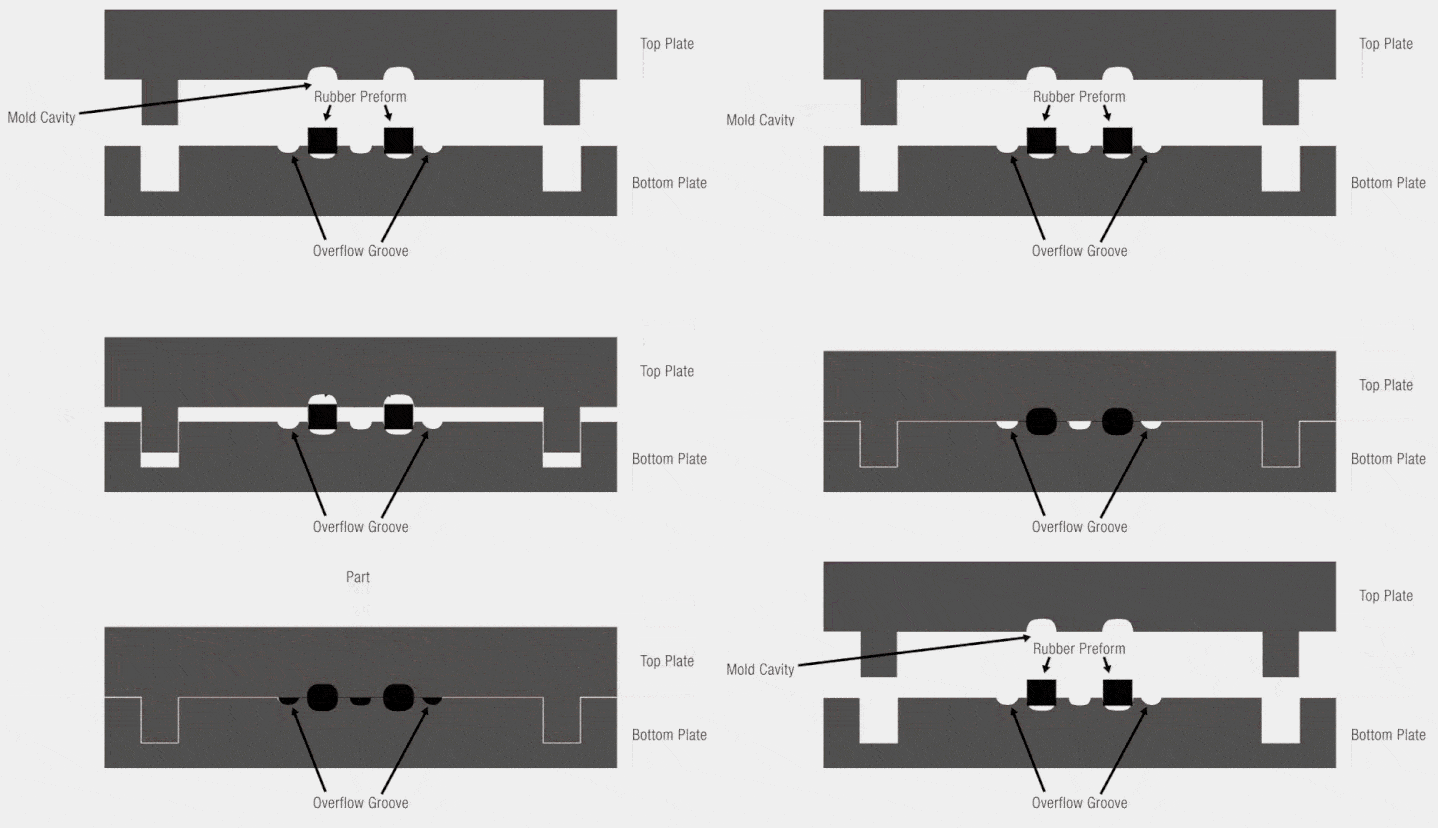
Many common composite molding defects—including porosity, blistering, under-curing, warpage, flash formation, dimensional variation, and inconsistent mechanical properties—can often be traced back to machine performance rather than mold design alone.
Modern compression molding machines are therefore engineered not only to generate force, but also to precisely control pressure profiles, platen temperature distribution, mold alignment accuracy, and real-time process monitoring.
Understanding the relationship between machine components and part quality is essential for achieving reliable manufacturing performance.
The hydraulic system is often considered the heart of a compression molding machine. However, its importance extends far beyond simply generating clamping force.
Modern compression molding presses utilize high-capacity hydraulic cylinders, servo-driven pumps, and precision proportional valves to create highly controlled pressure and velocity profiles throughout the molding cycle.
Rather than moving at a constant speed, the ram typically follows a carefully programmed multi-stage motion sequence:
This multi-stage velocity profile is particularly important when molding SMC and BMC materials.
During the early stages of mold closing, trapped air must be allowed to escape from the cavity. If excessive pressure is applied too quickly, air can become trapped inside the composite charge, resulting in internal porosity, blistering, and surface defects.
By carefully controlling closing speed and compression pressure, the hydraulic system enables efficient degassing before full compaction occurs.
During the curing phase, stable pressure distribution ensures proper resin flow, fiber consolidation, and dimensional accuracy throughout the entire component.
This is especially critical for large automotive exterior panels, EV battery covers, and structural composite components where internal voids can significantly reduce mechanical performance.
Among all machine components, the heating platen system may have the greatest influence on composite part quality.
While mold designers often focus on cavity geometry and material flow, resin curing behavior is fundamentally governed by temperature control.
Modern compression molding machines utilize electrically heated platens, oil-heated platens, or steam-heated systems designed to maintain highly uniform temperature distribution across the entire molding surface.
Advanced zoned heating systems can often achieve temperature control accuracy within approximately ±1°C across large mold areas.
This level of thermal precision is essential for ensuring synchronized resin curing throughout the mold cavity.
Without uniform heating, different regions of the molded part may cure at different rates. Uneven curing generates localized residual stresses that can ultimately cause:
For large SMC automotive body panels, battery enclosure covers, and BESS energy storage cabinet components, synchronized curing is critical for maintaining dimensional accuracy and surface quality.
By eliminating thermal gradients across the mold surface, high-precision platens help manufacturers achieve superior flatness, reduced internal stress, and highly consistent production results.
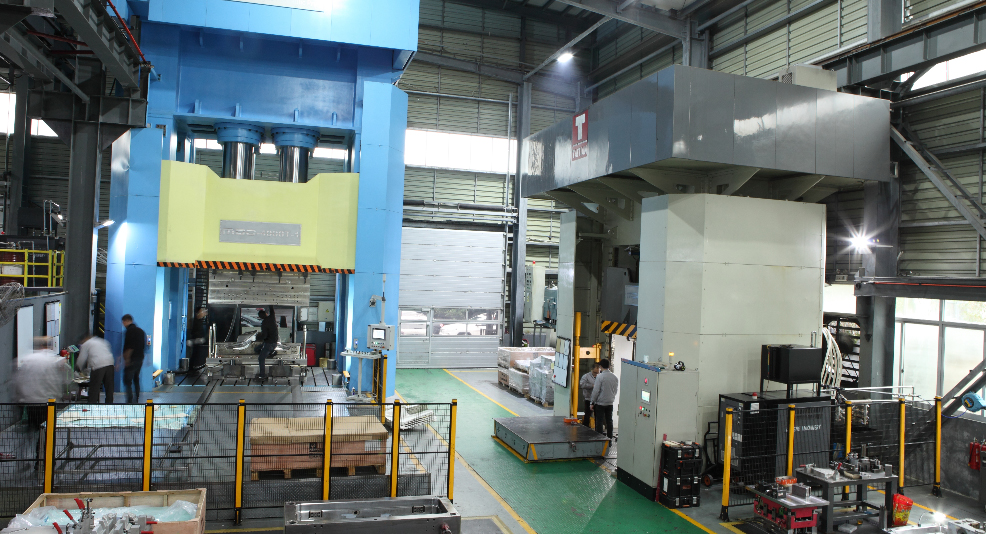
The movement accuracy of the machine slide or ram directly influences mold life and product quality.
During every molding cycle, the moving platen must travel vertically while maintaining perfect alignment with the stationary mold half.
To achieve this, compression molding machines utilize precision-engineered guide pillars, guide bushings, and advanced guiding systems.
Their function extends far beyond simple motion guidance.
In modern SMC tooling, many molds incorporate highly precise shear edge designs that help control flash formation and improve material flow behavior.
These shear edges often operate with extremely small clearances.
Even slight platen misalignment can create serious problems:
For high-volume automotive composite molds, alignment errors measured in only a few microns can significantly affect both mold longevity and product consistency.
High-precision guiding systems therefore serve as a critical safeguard for mold protection and long-term production stability.
The most advanced compression molding machines are no longer controlled solely through mechanical adjustments. Instead, they operate through sophisticated PLC-based control architectures integrated with intelligent Human Machine Interface (HMI) systems.
These digital control systems continuously monitor and record every critical production parameter throughout the molding cycle.
Key process variables include:
Rather than simply displaying machine status, these systems create a complete digital manufacturing record for every molded part.
This real-time data logging capability enables true closed-loop process control, allowing manufacturers to detect deviations immediately and maintain highly repeatable production conditions.
For automotive, aerospace, and energy storage applications, digital traceability has become an essential supplier qualification requirement.
OEMs increasingly require manufacturers to provide detailed process records demonstrating that every part was produced within specified process windows.
Without comprehensive data acquisition and traceability capabilities, entering high-end automotive EV supply chains or aerospace programs becomes increasingly difficult.
The true performance of a compression molding machine is not determined by any single component. Instead, quality results are achieved through the interaction of pressure control, temperature management, alignment precision, and intelligent process monitoring.
| Machine Component | Primary Quality Function | Defects Prevented |
|---|---|---|
| Hydraulic System | Multi-stage compression and degassing control | Porosity, blistering, voids |
| Heating Platens | Synchronized curing and thermal uniformity | Warpage, residual stress, distortion |
| Guide Pillars & Bushings | Mold alignment accuracy | Flash, shear edge wear, mold damage |
| PLC Control System | Closed-loop process monitoring | Process instability and quality variation |
As composite materials continue expanding into electric vehicles, battery enclosures, hydrogen energy systems, aerospace structures, and infrastructure applications, compression molding equipment is evolving from traditional hydraulic presses into intelligent manufacturing platforms.
Future systems will incorporate AI-assisted process optimization, predictive maintenance, digital twin technology, and fully integrated factory data networks.
However, regardless of future innovations, the fundamental relationship remains unchanged: superior composite products begin with superior machine control.
The parts of a compression molding machine do far more than support machine operation. Each component directly influences composite part quality, production efficiency, and long-term manufacturing reliability.
From multi-stage hydraulic pressure control and precision heating platens to alignment systems and real-time digital process monitoring, every subsystem contributes to defect prevention and product consistency.
For manufacturers producing SMC automotive components, EV battery enclosures, BMC electrical parts, and advanced composite structures, understanding these machine-to-quality relationships is essential for achieving world-class molding performance.
At MDC Mould, we believe that successful composite manufacturing is built upon the combination of advanced mold engineering and precision-controlled molding technology, ensuring reliable production and superior product quality across every application.
Contact US
Email: master@zjmdc.com
Tel: +86 576 84616076
Fax: +86 576 84616079
Mobile: +86 13906573507(Mr. Wang)
Address: No.116 mochuang road, Huangyan Xinqian street,Taizhou,Zhejiang,China