
Specialize in Compression molds
Specialize in Compression molds
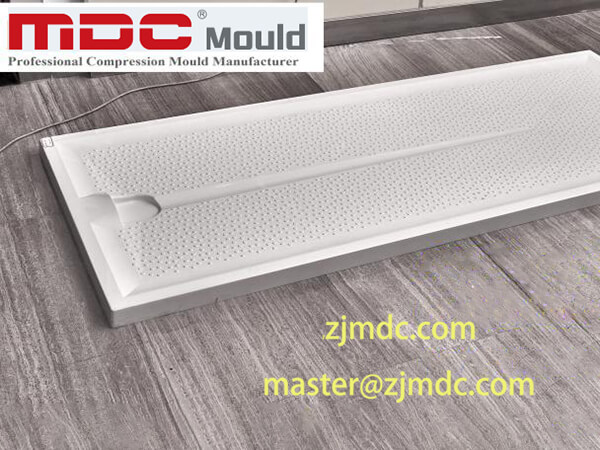
An SMC shower base is a large, relatively shallow composite component that must combine drainage performance, installation accuracy, surface quality and structural stability. These requirements place specific demands on the compression mould used to manufacture it.
For an SMC shower base mould manufacturer, the challenge is not simply to machine a cavity that matches the product shape. The mould must also support consistent material flow, controlled curing, reliable demoulding and repeatable dimensional results across the entire moulding surface.
MDC Mould focuses on composite compression mould manufacturing. For SMC shower bases and shower trays, mould engineering needs to consider drainage geometry, drain opening interfaces, peripheral flanges, anti-slip textures, heating arrangements and parting-line control as an integrated system.
SMC (Sheet Moulding Compound) is a fibre-reinforced thermosetting composite material commonly processed through compression moulding. It offers design flexibility and the potential to manufacture large sanitaryware components with integrated geometry and functional surface details.
However, a shower base is different from many conventional flat composite panels. Its geometry must guide water toward the drain while maintaining stable interfaces with surrounding walls, floors and installation structures.
A moulding defect in one local area can affect the overall performance of the finished product. For example, an uneven drainage surface may leave standing water, while flange distortion may complicate installation or sealing.
Therefore, SMC shower base mould design should address several connected engineering requirements:
Drainage performance is one of the most important functional requirements of an SMC shower base. The mould cavity must reproduce the intended drainage profile so that water can move toward the drain without unwanted local depressions or geometric interruptions.
The drainage slope is determined by the shower base design, drain location, product dimensions and applicable installation requirements. There is no single slope value that should automatically be applied to every shower base.
During mould development, the engineering team should review:
CNC machining of the cavity should follow the approved product geometry. Where the design includes multiple drainage directions or complex surface transitions, these features should be checked against the CAD model before mould manufacturing is completed.
The drain opening is a critical interface between the shower base and the drainage fitting. Its position, diameter, surrounding geometry and sealing surface can affect assembly and water-tightness.
Mould design should consider the complete drain assembly rather than treating the opening as an isolated hole. Important inputs include:
If the product uses a specific drain fitting, its technical drawing or physical sample should be provided during the mould design stage. This helps reduce the risk of interface mismatch during assembly.
Dimensional inspection alone cannot fully confirm drainage performance. A shower base may meet selected drawing dimensions while still showing unexpected water retention due to local surface variation or the interaction of multiple slopes.
Trial validation should therefore include a drainage test using the agreed product orientation and installation conditions. The test should identify:
The peripheral flange of an SMC shower base is not merely an edge feature. Depending on the product design, it may provide a connection surface for wall panels, supporting structures, installation components or sealing systems.
Dimensional variation in these areas can create installation difficulties even when the central drainage surface appears acceptable.
Before mould construction, the engineering team should identify the flange dimensions that directly influence product assembly. These may include:
Critical dimensions should be defined in the product drawing with appropriate tolerances. The mould design and inspection plan should then use the same datum system wherever practical.
Large shower base moulds require sufficient structural rigidity to maintain the intended cavity relationship during compression moulding. Mould alignment, guide components, supporting structure and clamping conditions all contribute to repeatable part geometry.
If the mould structure is insufficiently rigid or the alignment system is not properly controlled, the resulting product may show inconsistent flange dimensions, uneven parting-line gaps or local flash variation.
For this reason, flange accuracy should be considered together with:
SMC compression moulding depends on controlled heat and pressure to form and cure the thermosetting material. The mould heating system is therefore a key part of shower base mould engineering.
A large cavity can contain areas with different geometric thicknesses, surface features and thermal conditions. If the heating arrangement does not adequately address these differences, curing consistency and dimensional stability may become difficult to control.
The heating circuit should be developed around the mould structure and cavity geometry. Its design needs to consider the location of heating channels, heat transfer paths, mould thickness and the temperature requirements specified for the selected SMC material.
Depending on the project and available production equipment, the heating arrangement may use an appropriate thermal-fluid or electrical heating solution. The final configuration should be determined by the mould structure, press setup and process requirements.
Uniform temperature distribution is important for consistent curing across the moulding surface. Large temperature differences may contribute to variations in curing behaviour, local shrinkage and finished-part distortion.
Mould engineering should therefore consider:
Actual temperature settings and allowable variations must be established according to the selected SMC compound, product design and validated production process. They should not be treated as universal values for all shower base moulds.
Warpage is a common concern when manufacturing large composite components. For SMC shower bases, dimensional distortion can affect drainage geometry, flange alignment, installation interfaces and the overall appearance of the finished product.
Warpage should not be attributed to mould design alone. It may result from the combined effects of material characteristics, charge distribution, mould temperature, curing conditions, part geometry, cooling behaviour and demoulding.
A large shower base cavity requires a mould structure capable of maintaining its geometry under the specified moulding conditions. Structural design should consider the mould's overall dimensions, supporting sections, press interface and expected loading conditions.
The placement and quantity of SMC charge influence how material flows through the cavity. Inadequate charge distribution may contribute to incomplete filling, uneven fibre distribution or inconsistent local thickness.
Charge placement should therefore be developed with reference to the product geometry, material flow characteristics, required thickness and trial results.
The finished component may continue to change dimensionally during cooling and after release from the mould. Large surface areas and complex flange transitions can make these effects more noticeable.
Mould design should consider suitable draft, release conditions and structural support. During trial moulding, dimensional inspection should be carried out at an agreed stage after demoulding so that measurements can be compared consistently.
Many SMC shower bases incorporate textured surfaces to provide a particular appearance and functional surface profile. These textures may include patterned regions, embossed details or other anti-slip design features.
The mould cavity must reproduce these features accurately while allowing the finished component to release reliably.
Texture design should be based on the product drawing, approved surface sample or agreed visual specification. The engineering review should consider pattern depth, edge definition, spacing, transition areas and consistency across the visible surface.
Different regions of a shower base may require different surface treatments. A visible smooth area, textured standing area and concealed flange do not necessarily share the same finishing requirements.
Mould surface finishing should therefore be defined by functional zone rather than applying one general finishing specification to the entire cavity.
Deep or complex textures can increase demoulding sensitivity. Draft angles, surface transitions and release conditions should be reviewed to reduce the risk of sticking, surface damage or inconsistent reproduction of the texture.
The final surface treatment should be selected according to the SMC material, product appearance requirements, texture design and expected production conditions.
Flash is excess material that escapes from the cavity or parting-line region during compression moulding. Some flash may be expected in the process, but uncontrolled flash can increase trimming work and affect the appearance or edge quality of the shower base.
Large sanitaryware moulds require careful control of the parting surface, mould alignment and material charge.
The parting line should be positioned with consideration for the product's visible surfaces, flange geometry and trimming requirements. The mould design should also consider the relationship between the cavity edge and the finished component boundary.
Flash control should be addressed through mould design, machining, assembly inspection and process validation. The parting surface should be checked during mould assembly and trial moulding, while the charge and process conditions should be adjusted according to actual production results.
The following matrix summarizes the relationship between common shower base manufacturing challenges and the corresponding mould engineering considerations.
| Engineering Area | Manufacturing Challenge | Mould Design Considerations | Validation Method |
|---|---|---|---|
| Drainage Geometry | Incorrect slope or local depressions may cause residual water. | CNC-machined cavity geometry based on specified drainage profiles and drain positions. | Dimensional inspection and drainage testing. |
| Drain Interface | Dimensional mismatch may affect fitting installation and sealing. | Accurate drain opening location and interface geometry based on fitting specifications. | Fitting assembly and sealing verification. |
| Flange Accuracy | Dimensional deviation may affect wall interfaces and installation. | Precision machining and dimensional inspection of critical flange surfaces. | Reference-datum measurement and assembly checks. |
| Heating System | Uneven temperature distribution may contribute to inconsistent curing. | Heating circuit design, temperature monitoring and trial validation. | Temperature measurement during mould trials. |
| Dimensional Stability | Large-area distortion may affect drainage and installation dimensions. | Rigid mould structure, appropriate cavity geometry and controlled demoulding conditions. | Dimensional inspection after demoulding and cooling. |
| Anti-Slip Texture | Inconsistent texture may affect appearance and surface functionality. | Accurate cavity texturing, surface finishing and demoulding evaluation. | Visual inspection and approved surface-sample comparison. |
| Parting Line | Excessive flash increases trimming work and may damage product edges. | Parting-surface accuracy, mould alignment and controlled material charge. | Flash inspection and trimming evaluation. |
Final tolerances, temperature settings and acceptance criteria should be agreed in the project drawings, technical specifications and mould trial plan.
A successful SMC shower base mould project requires more than completing mould machining. Trial moulding is necessary to evaluate whether the mould can produce parts that meet the agreed product requirements.
A structured trial process should cover the following areas:
If defects appear during the trial, the cause should be identified before making mould modifications. Some issues may originate from material charge placement, temperature, pressure or curing conditions rather than the cavity itself.
A systematic troubleshooting process helps distinguish mould-related problems from material and process-related problems, reducing unnecessary machining changes.
| Observed Defect | Possible Causes | Recommended Investigation |
|---|---|---|
| Standing water on the finished surface | Drainage profile deviation, local surface depression or product distortion. | Check cavity geometry, finished-part dimensions and drainage test results. |
| Flange dimensional variation | Mould alignment, structural deformation, curing variation or cooling effects. | Inspect mould structure, reference dimensions and process consistency. |
| Excessive flash | Parting-surface mismatch, charge quantity, alignment or process conditions. | Inspect parting surfaces and review charge and moulding parameters. |
| Incomplete surface texture | Material flow limitations, cavity contamination or unsuitable process conditions. | Inspect texture details, cavity condition and material flow during trials. |
| Surface sticking or demoulding damage | Insufficient draft, surface condition or unsuitable release conditions. | Review draft geometry, surface finishing and demoulding procedure. |
| Warpage after demoulding | Uneven curing, material distribution, cooling behaviour or structural imbalance. | Review heating distribution, charge placement, curing conditions and dimensional results. |
These are potential causes rather than automatic diagnoses. The correct corrective action should be based on inspection data, trial observations and the actual SMC material and production process.
Choosing an SMC shower base mould manufacturer involves more than comparing mould quotations. Buyers should evaluate whether the supplier has the engineering and manufacturing capability to manage large composite compression moulds and understand the functional requirements of sanitaryware products.
The supplier should understand SMC material behaviour, compression mould construction, material flow, heating arrangements and trial moulding requirements.
Large shower base cavities require appropriate machining capacity and inspection methods. Buyers should review the supplier's machining equipment, maximum workpiece dimensions and experience with large mould structures.
The mould manufacturer should be able to explain how the heating arrangement, structural design and alignment system are developed for the specific product.
A capable supplier should have a defined process for mould inspection, trial evaluation, defect analysis and technical adjustment. This is especially important for large sanitaryware components where drainage, flange dimensions and surface quality must work together.
Buyers can also review the supplier's broader compression mould manufacturing capabilities and relevant SMC mould solutions before starting a project.
MDC Mould specializes in composite compression mould manufacturing, including tooling for SMC and other composite material applications.
For SMC shower base and shower tray projects, mould engineering requires coordinated attention to product geometry, cavity machining, heating systems, surface finishing, mould structure and trial validation.
MDC's manufacturing capabilities include FIDIA five-axis CNC machining and large-scale mould manufacturing facilities. The available machining envelope and mould handling capacity should be assessed against each project's actual dimensions and weight.
MDC also manufactures compression moulds for a range of composite applications. Buyers looking for broader tooling information can explore the company's compression mould manufacturing solutions.
The final mould configuration, manufacturing schedule and technical specifications are determined according to the product design, SMC material, production requirements and project scope.
To evaluate an SMC shower base mould project efficiently, buyers should provide as much of the following information as possible:
Complete technical information helps the mould manufacturer assess the mould structure, machining requirements, heating design and trial plan before preparing a quotation.
An SMC shower base mould is a compression mould used to manufacture shower bases from Sheet Moulding Compound, a fibre-reinforced thermosetting composite material. The mould forms the product's drainage surface, drain opening, flange geometry and surface texture under controlled heat and pressure.
Key considerations include drainage geometry, drain-interface accuracy, flange dimensions, mould heating, dimensional stability, surface finishing, demoulding and parting-line control. These factors should be evaluated together according to the finished product's requirements.
Drainage performance can be checked through a water-flow test using the agreed installation orientation. The test should evaluate whether water moves toward the intended drain and whether local standing-water areas remain on the finished surface.
Warpage may be associated with uneven curing, material distribution, mould temperature, cooling behaviour, product geometry or demoulding conditions. Investigation should consider both mould design and the actual compression moulding process.
The heating system supports the temperature conditions required for SMC curing. Its layout and temperature distribution can influence curing consistency and finished-part dimensional stability. The appropriate configuration depends on the mould structure, material and production process.
Not necessarily. Different shower base sizes may have different drainage profiles, flange interfaces, cavity structures and production requirements. Each product should be evaluated against its own drawings and technical specifications to determine whether a common mould design is practical.
Buyers should ideally provide 2D drawings, 3D CAD files, material specifications, product weight and thickness, drain fitting details, surface requirements, production volume and available press information. These inputs help the mould manufacturer assess the project scope and prepare a technical quotation.
MDC Mould manufactures custom composite compression moulds. SMC shower base and shower tray tooling projects can be evaluated according to the buyer's product drawings, material requirements, press conditions and production objectives.
Planning a new SMC shower base or shower tray project? MDC Mould provides custom compression mould manufacturing for sanitaryware applications, with engineering considerations covering drainage geometry, flange interfaces, surface finishing, heating systems and dimensional control.
Send your 2D drawings, 3D CAD files, material specifications and production requirements to our engineering team for a technical review and mould quotation.
Email: master@zjmdc.com
Contact US
Email: master@zjmdc.com
Tel: +86 576 84616076
Fax: +86 576 84616079
Mobile: +86 13906573507(Mr. Wang)
Address: No.116 mochuang road, Huangyan Xinqian street,Taizhou,Zhejiang,China