
Specialize in Compression molds
Specialize in Compression molds
Compression molding remains one of the most widely used manufacturing processes for producing SMC molds, BMC molds, carbon fiber composite components, and large structural thermoset parts.
Due to its advantages in producing lightweight, high-strength, and cost-effective composite products, compression molding is extensively applied in:
However, despite its many advantages, manufacturers often ask an important question:
Like any manufacturing technology, compression molding has certain process limitations and engineering challenges. Understanding these disadvantages is critical for improving mold design, optimizing production efficiency, and enhancing composite product quality.
Fortunately, with advances in composite molding technology, many traditional compression molding problems can now be significantly reduced through better tooling engineering, optimized process control, and advanced material systems.
One of the most commonly discussed disadvantages of compression molding is its relatively long production cycle.
Unlike injection molding, where molten material rapidly fills the cavity, compression molding requires:
For thermoset materials such as SMC (Sheet Molding Compound) and BMC (Bulk Molding Compound), the curing process often increases total cycle time.
Depending on product thickness and material type, a molding cycle may range from several minutes to much longer for large structural components.
Today, advanced manufacturers improve cycle efficiency through:
Modern compression molding systems can significantly reduce production time while maintaining stable product quality.
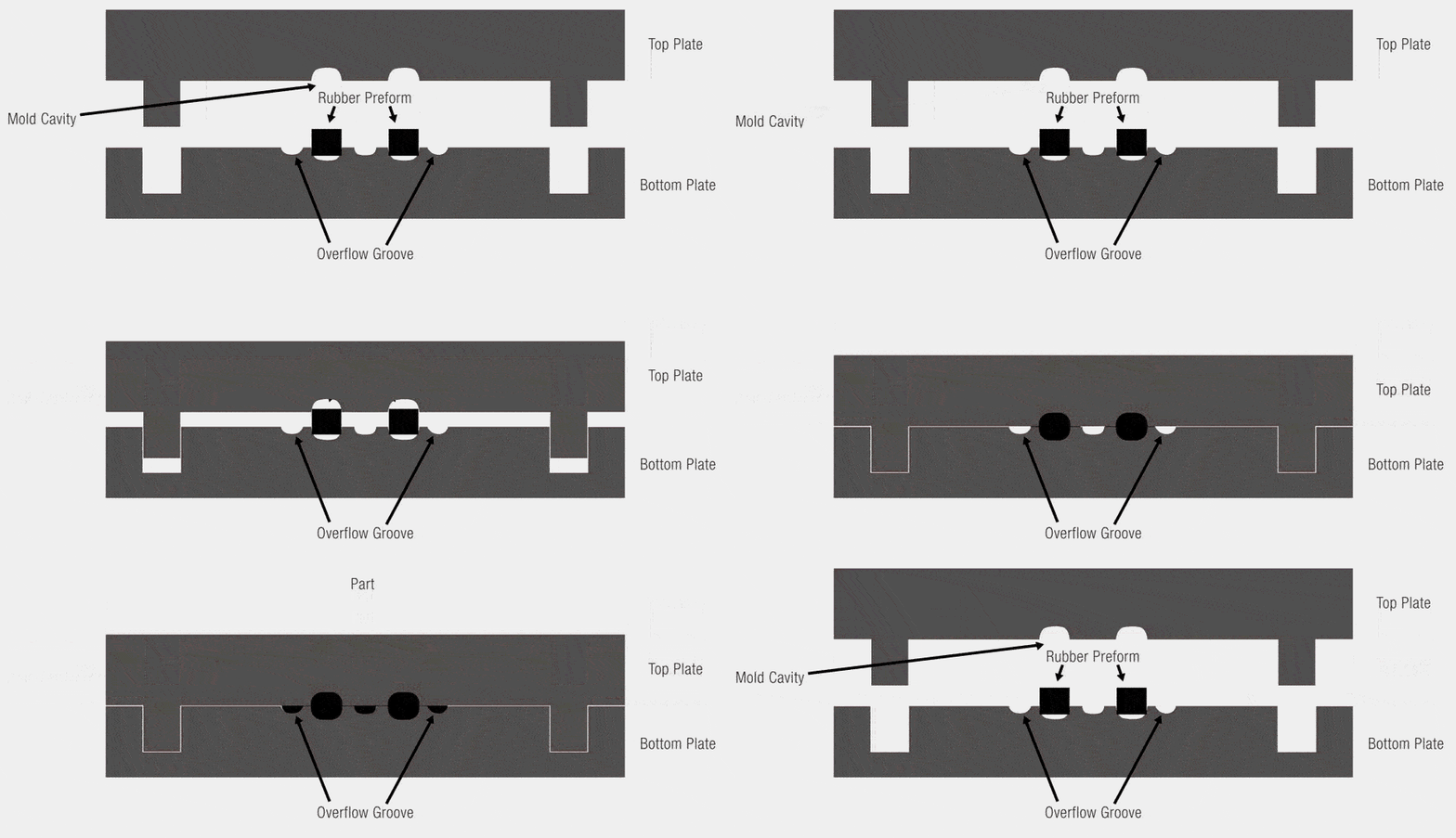
Another common compression molding limitation is the formation of flash around molded parts.
During the compression process, excess material may flow outside the mold cavity, creating thin unwanted edges commonly referred to as flash.
Flash formation may result in:
Advanced compression mold design now minimizes flash through:
Precision CNC machining and improved mold tolerances help significantly reduce excess flash generation.
Although compression molding is generally cost-effective for mass production, initial tooling investment may still be significant for large or complex composite molds.
High-quality compression molds often require:
Large automotive SMC molds and carbon fiber compression molds may involve considerable engineering and manufacturing costs.
Advanced mold engineering helps improve tooling return on investment through:
For high-volume production, the cost per part becomes highly competitive over time.
Compared with injection molding, traditional compression molding may have limitations when producing:
This limitation mainly results from the flow characteristics of thermoset composite materials.
Insufficient material flow may lead to:
Modern composite manufacturing technologies now improve molding complexity through:
Advanced engineering allows manufacturers to produce increasingly complex composite structures with high dimensional accuracy.
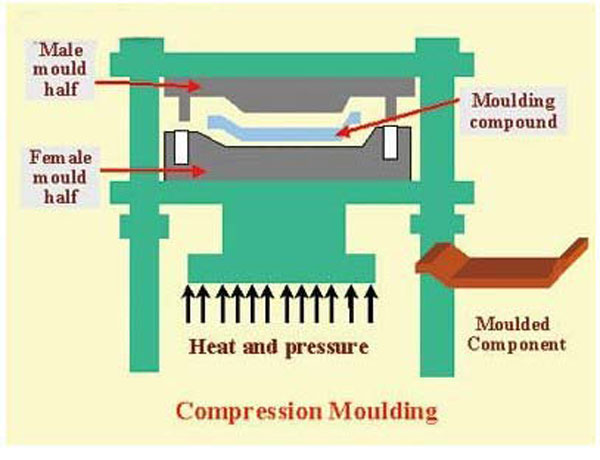
Although compression molding generally offers good material utilization, process inconsistency may still result in:
The quality of compression molded products is highly influenced by:
Today’s intelligent molding systems improve consistency through:
These technologies significantly improve product repeatability and reduce scrap rates.
One important challenge in thermoset compression molding is recyclability.
Unlike thermoplastic materials, thermoset composites undergo irreversible chemical curing during molding.
As a result:
The composite industry is actively developing:
New sustainable composite materials are expected to improve the environmental performance of future compression molding systems.
Compression molding requires highly controlled processing conditions.
Improper control of:
may lead to:
Advanced process optimization technologies now include:
These technologies greatly improve molding stability and composite product quality.
Despite these challenges, compression molding remains one of the most important manufacturing technologies for high-performance composite products.
Compared with many alternative processes, compression molding still offers:
This is why compression molding continues to play a major role in:
Understanding the disadvantages of compression molding is essential for improving product quality, optimizing tooling systems, and enhancing manufacturing efficiency.
While traditional compression molding may involve challenges such as:
modern advancements in:
are continuously overcoming these limitations.
As composite manufacturing technology evolves, compression molding will remain a critical solution for producing lightweight, durable, and high-performance composite components across multiple industries.
Contact US
Email: master@zjmdc.com
Tel: +86 576 84616076
Fax: +86 576 84616079
Mobile: +86 13906573507(Mr. Wang)
Address: No.116 mochuang road, Huangyan Xinqian street,Taizhou,Zhejiang,China