
Specialize in Compression molds
Specialize in Compression molds
Composite manufacturing is evolving as manufacturers seek lighter structures, improved production efficiency, more predictable part quality, and better material utilization. Developments in thermoplastic composites, recycling, digital engineering, automation, and intelligent tooling are creating new opportunities across automotive, transportation, electrical, agricultural, and industrial applications.
However, new materials and digital technologies do not automatically translate into successful mass production. Their industrial value depends on how effectively material properties, part geometry, manufacturing processes, mold design, and quality-control systems work together.
For manufacturers developing composite components, the central engineering question is not simply which technology is newest. It is whether that technology can meet the required performance, cost, cycle time, dimensional accuracy, and production-volume targets.
This article examines eight important trends in advanced composite manufacturing and explains how each may influence composite tooling, compression moulding tooling, SMC mould manufacturing, and carbon fiber mold design.
Thermoplastic composites are fiber-reinforced materials that use a thermoplastic polymer matrix. The matrix can generally soften when heated and solidify during cooling, allowing suitable material systems to be formed, consolidated, and joined through selected manufacturing processes.
These materials are attracting attention in applications where lightweight structures, high-rate production, part integration, or potential material recovery are important. Depending on the polymer, reinforcement architecture, and component design, thermoplastic composites may be processed through compression molding, injection molding, overmolding, or forming of continuous-fiber laminates.
Thermoplastic processing can require carefully coordinated heating, forming pressure, consolidation, cooling, and demolding. Tooling must be designed around the selected polymer, reinforcement architecture, material format, and target cycle.
Temperature distribution and cooling behavior are particularly important because uneven thermal conditions can contribute to residual stress, shrinkage variation, and warpage. For production tooling, the objective is to establish a repeatable processing window while maintaining the required geometry and surface quality.
Manufacturers evaluating this technology can explore MDC's related guide to thermoplastic composite molding and tooling design.
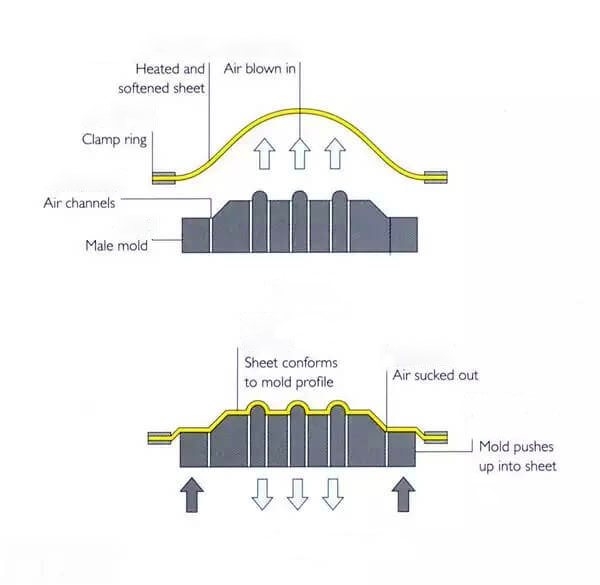
Composite recycling involves recovering materials from manufacturing scrap or end-of-life composite products and preparing them for reuse or other recovery routes. Its feasibility depends on the matrix chemistry, reinforcement type, contamination, component construction, and available recycling infrastructure.
Sustainability is becoming an important consideration as manufacturers assess material waste, energy consumption, product durability, and end-of-life options. Potential approaches include reducing production scrap, using qualified recycled reinforcement, designing components for easier separation, and improving manufacturing yield.
Recycled fibers do not necessarily perform like virgin reinforcement. Fiber length, surface condition, residual resin, contamination, orientation, and processing history can influence the mechanical performance and consistency of the resulting composite.
For this reason, sustainable composite manufacturing should be evaluated using application-specific performance requirements rather than recyclability claims alone. Material recovery must be considered alongside product durability, manufacturing yield, energy use, and the intended end market for recovered material.
Material changes can affect charge placement, flow behavior, cavity filling, surface finish, and process stability. A recycled-fiber compound may behave differently from a continuous-fiber laminate even when both contain the same type of reinforcement.
Mold development should therefore be based on the actual material specification and production route. Consistent tooling and process control can help reduce avoidable scrap, but the environmental benefit must be assessed across the complete manufacturing and recovery system.
AI-assisted composite engineering uses data-driven methods to help analyze manufacturing information, identify patterns, estimate outcomes, or support engineering decisions. When combined with physics-based simulation and engineering validation, these tools may improve the efficiency of composite design and process development.
Composite components can be difficult to predict because material behavior may depend on fiber orientation, local thickness, anisotropy, temperature, pressure, curing or consolidation, and interactions between different manufacturing stages.
AI predictions and simulation results are only as reliable as their assumptions, input data, models, and validation methods. Material variability, equipment behavior, boundary conditions, and manufacturing details may limit how accurately a model represents real production.
A practical digital engineering workflow combines analysis with physical trials, dimensional inspection, material testing where required, and production feedback. The objective is to reduce uncertainty and prioritize engineering work, not to eliminate verification.
Digital engineering can help tooling teams investigate draft angles, local thickness changes, potential material-flow restrictions, thermal behavior, and dimensional risks before or during tool development. These insights can support more informed decisions about mold geometry, venting, heating and cooling arrangements, and trial plans.
The greatest value often comes from connecting design information to measurable production outcomes rather than treating simulation as a standalone deliverable.
Smart tooling refers to manufacturing tooling supported by sensors, data acquisition, or connected monitoring systems that provide information about selected operating conditions. Depending on the application, this may include temperature, pressure, cycle timing, equipment status, or other measurable process variables.
In composite production, the same nominal machine settings do not always guarantee identical part quality. Material batches, mold thermal conditions, charge placement, equipment variation, and tooling wear can influence the outcome.
Collecting data alone does not guarantee better quality. Measurements must be relevant to the manufacturing process, collected consistently, and interpreted against appropriate operating limits.
A useful implementation begins by identifying the defect or process variation that needs to be controlled. The team can then determine which variables to measure, where to measure them, how to define acceptable ranges, and what action should follow an abnormal result.
For compression molding, temperature consistency, pressure application, closing sequence, and effective air evacuation can all influence part quality. The appropriate monitoring strategy depends on the material system, mold design, equipment, and production requirements.
Composite manufacturing automation uses automated equipment or coordinated production systems to perform selected operations such as material handling, charge placement, mold loading, part removal, trimming, inspection, or transfer between process stages.
Automation can improve repeatability and reduce manual handling, particularly in applications with stable product designs and sufficient production volume. However, the achievable benefit depends on cycle time, material variability, part geometry, equipment integration, and the reliability of the overall process.
A mold intended for automated production may require defined robot access, reliable part location, repeatable release behavior, suitable locating features, and sufficient clearance for handling equipment.
The tooling concept should also consider loading orientation, insert positioning, safety interlocks, sensor locations, maintenance access, and the sequence in which the mold opens and the part is removed.
Automation should be evaluated as a complete production-system decision. A faster robot does not necessarily improve overall output if the mold cycle, material preparation, downstream trimming, or inspection remains the bottleneck.
Advanced fiber architectures describe how reinforcement is arranged within a composite, including fiber length, orientation, layering, textile structure, and the combination of different reinforcement forms. These characteristics influence stiffness, strength, impact behavior, flow, and manufacturability.
Hybrid composites may combine different fibers, matrix systems, or reinforcement formats to balance performance, weight, cost, and process requirements. The suitability of a particular architecture depends on the load case, component geometry, operating environment, and production route.
Reinforcement architecture affects how material can be formed and how it behaves inside the mold. Continuous fibers may be sensitive to wrinkling, bridging, or unwanted changes in orientation. Short-fiber materials may be affected by flow-induced orientation and local variations in fiber concentration.
Tooling must account for these differences through appropriate cavity geometry, material placement, forming sequence, surface details, and process conditions. Design decisions should be based on the actual reinforcement format rather than treating all fiber-reinforced materials as interchangeable.
For a related engineering discussion, see MDC's guide to reinforced composite structures and tooling design.
Multifunctional composites are engineered to provide more than their primary structural role. Depending on the material system, they may integrate electrical conductivity, sensing, thermal management, electromagnetic functions, or other application-specific properties.
Self-healing composites are a related research area in which material systems are designed to repair certain types of damage through mechanisms such as reversible chemical bonding, embedded healing agents, or other engineered responses. The practical effectiveness depends on the damage mechanism, material design, operating conditions, and validation method.
Multifunctional and self-healing materials should not be assumed to be commercially suitable for every application. Their benefits must be demonstrated against defined performance requirements, durability targets, manufacturing constraints, and total cost.
Integration can also increase tooling and process complexity. Embedded components, conductive elements, sensors, or specialized material layers may require precise positioning, controlled thermal exposure, compatible interfaces, and additional inspection.
For tooling engineers, the key question is how to manufacture the intended function consistently without compromising dimensional accuracy, structural integrity, cycle time, or long-term reliability.
Advanced composite tooling includes the mold design, mold construction, thermal systems, venting features, material-control features, and supporting engineering needed to manufacture composite parts consistently. As materials and production systems become more sophisticated, tooling must be developed around the actual material and process rather than treated as a standalone metal component.
This trend is directly relevant to compression moulding tooling, SMC mould manufacturing, BMC mold design, GMT and LFT tooling, PCM tooling, and carbon fiber mold design.
Different composite materials have different flow, thermal, curing, consolidation, and demolding requirements. A tool designed for a thermoset SMC process cannot automatically be transferred to a thermoplastic composite process without reviewing the relevant process conditions.
Material selection, reinforcement format, part geometry, production volume, press specifications, surface requirements, and dimensional tolerances should all be considered during tooling development.
Mold temperature distribution can affect material flow, curing or consolidation, shrinkage, and surface quality. Inconsistent thermal behavior may contribute to warpage or dimensional variation.
Depending on the process, tooling development may require analysis of heating layout, cooling-channel arrangement, thermal expansion, mold stiffness, and the relationship between local part thickness and heat transfer.
For compression-molded parts, charge location and cavity geometry influence how the material spreads during mold closing. Venting and parting-line design influence air evacuation and material containment, while shear-edge geometry can affect flash control and trimming requirements.
These features should be designed together with the material specification and production process. Changing one feature in isolation may not solve a defect caused by several interacting variables.
Accurate machining is essential, but final tooling performance also depends on assembly, mold alignment, structural rigidity, thermal behavior, and compatibility with the production press.
Tool trials should evaluate the actual component against defined acceptance criteria. Depending on the project, validation may include dimensional inspection, surface assessment, process repeatability, cycle-time review, and verification of relevant functional requirements.
MDC's related technical article explains how composite compression molding process optimization and tooling design influence material flow, thermal management, venting, flash control, and production stability.
The eight trends do not represent one universal manufacturing route. Thermoplastic composites, recycled reinforcement, AI-assisted engineering, smart tooling, and automation address different challenges and may deliver value under different operating conditions.
Manufacturers should evaluate each technology against the requirements of the component, the production system, and the intended market.
| Technology Trend | Potential Manufacturing Benefit | Key Engineering Consideration |
|---|---|---|
| Thermoplastic composites | Process integration and potential material recovery | Heating, consolidation, cooling, and dimensional stability |
| Composite recycling | Material recovery and reduced waste in suitable applications | Recycled material qualification and process consistency |
| AI and digital simulation | More efficient analysis and engineering decisions | Input data quality and physical validation |
| Smart tooling | Improved process visibility and deviation detection | Relevant measurements and actionable limits |
| Automation | Repeatability and reduced manual handling | Equipment integration and overall cycle balance |
| Advanced fiber architectures | Application-specific structural performance | Fiber orientation, forming behavior, and material placement |
| Multifunctional composites | Integration of selected structural and functional properties | Material compatibility, durability, and validation |
| Advanced composite tooling | More consistent part quality and production performance | Material-specific design, precision machining, and trials |
Before adopting a new material or manufacturing technology, engineering and purchasing teams should consider the following questions:
A structured evaluation helps manufacturers distinguish promising research from technologies that are ready for a specific production application.
As a composite mold manufacturer, MDC (DaCheng Mold) focuses on translating component requirements and material-processing conditions into practical industrial tooling. Its composite tooling scope includes SMC, BMC, GMT, LFT, PCM, and carbon fiber mold projects, subject to the requirements of each application.
Effective tooling development requires more than producing the cavity geometry. It involves understanding the component, evaluating the material and forming process, coordinating mold construction with the available equipment, and validating the tool against the required production conditions.
MDC's manufacturing resources include FIDIA five-axis CNC machining and large-format tooling manufacturing capabilities. For suitable projects, machining dimensions can reach approximately 6 × 4 meters, subject to the specific tooling configuration and manufacturing requirements.
The appropriate tooling solution depends on factors such as part geometry, material specification, reinforcement architecture, target production volume, press capacity, thermal requirements, surface finish, dimensional tolerances, and expected tooling life.
To learn more about MDC, visit the MDC composite mold manufacturing website.
Important trends include thermoplastic composites, composite recycling, AI-assisted simulation, smart tooling, manufacturing automation, advanced fiber architectures, multifunctional materials, and more integrated composite tooling. Their commercial relevance depends on the material system and target application.
Thermoplastic composite tooling may need to accommodate specific heating, forming, consolidation, cooling, and demolding requirements. Temperature distribution, mold stiffness, material placement, and dimensional stability should be considered together.
Recycled fibers can be suitable for selected applications, but they should not automatically be treated as equivalent to virgin reinforcement. Fiber condition, length, contamination, orientation, material consistency, and application-specific performance must be evaluated.
AI-assisted methods can help analyze manufacturing data, identify patterns, compare design options, and support process investigations. Their results depend on data quality and model suitability and should be validated through appropriate engineering analysis and physical testing.
Smart tooling uses sensors or connected monitoring systems to collect information about selected conditions, such as temperature, pressure, cycle timing, or tooling status. The data can support process monitoring when measurements are relevant and linked to defined operating limits.
Automated production requires repeatable loading, positioning, mold opening, part removal, and equipment access. Mold design should account for robot clearance, locating features, handling sequence, maintenance, and integration with the overall production cell.
Useful RFQ information includes 3D CAD data, 2D drawings, material and reinforcement specifications, production volume, target cycle time, press specifications, dimensional tolerances, surface requirements, heating and cooling needs, and validation criteria.
Not always. The need for new or modified tooling depends on the material, process route, part geometry, equipment compatibility, and quality requirements. A technical review is needed to determine whether existing tooling can be adapted safely and effectively.
MDC can review project requirements for suitable SMC, BMC, GMT, LFT, PCM, and carbon fiber tooling applications. The tooling concept should be developed around the component design, material system, process conditions, equipment, and required production performance.
Selecting the right composite material is only one part of a successful manufacturing strategy. The mold must also support the required geometry, material behavior, production process, and quality standards.
If you are developing an SMC or BMC compression mold, GMT or LFT tooling, PCM tooling, or a carbon fiber mold, MDC can review your project requirements and discuss the appropriate tooling approach.
To support an initial engineering review, prepare your part drawings or 3D CAD data, material specification, target production volume, press information, dimensional tolerances, and cycle-time objectives.
Contact MDC's engineering team to discuss your composite tooling project.
The future of composite manufacturing will be shaped by advances in materials, digital engineering, recycling, automation, process monitoring, and tooling design. These developments can create new opportunities, but their value depends on whether they solve a defined manufacturing problem and meet measurable production requirements.
For industrial manufacturers, the most practical strategy is to connect material selection with part design, process capability, tooling engineering, and physical validation from the beginning of product development.
MDC (DaCheng Mold) works across composite tooling applications including SMC, BMC, GMT, LFT, PCM, and carbon fiber molds. By aligning tooling design with material behavior and production requirements, manufacturers can build a more reliable path from composite design to repeatable industrial production.
Contact US
Email: master@zjmdc.com
Tel: +86 576 84616076
Fax: +86 576 84616079
Mobile: +86 13906573507(Mr. Wang)
Address: No.116 mochuang road, Huangyan Xinqian street,Taizhou,Zhejiang,China